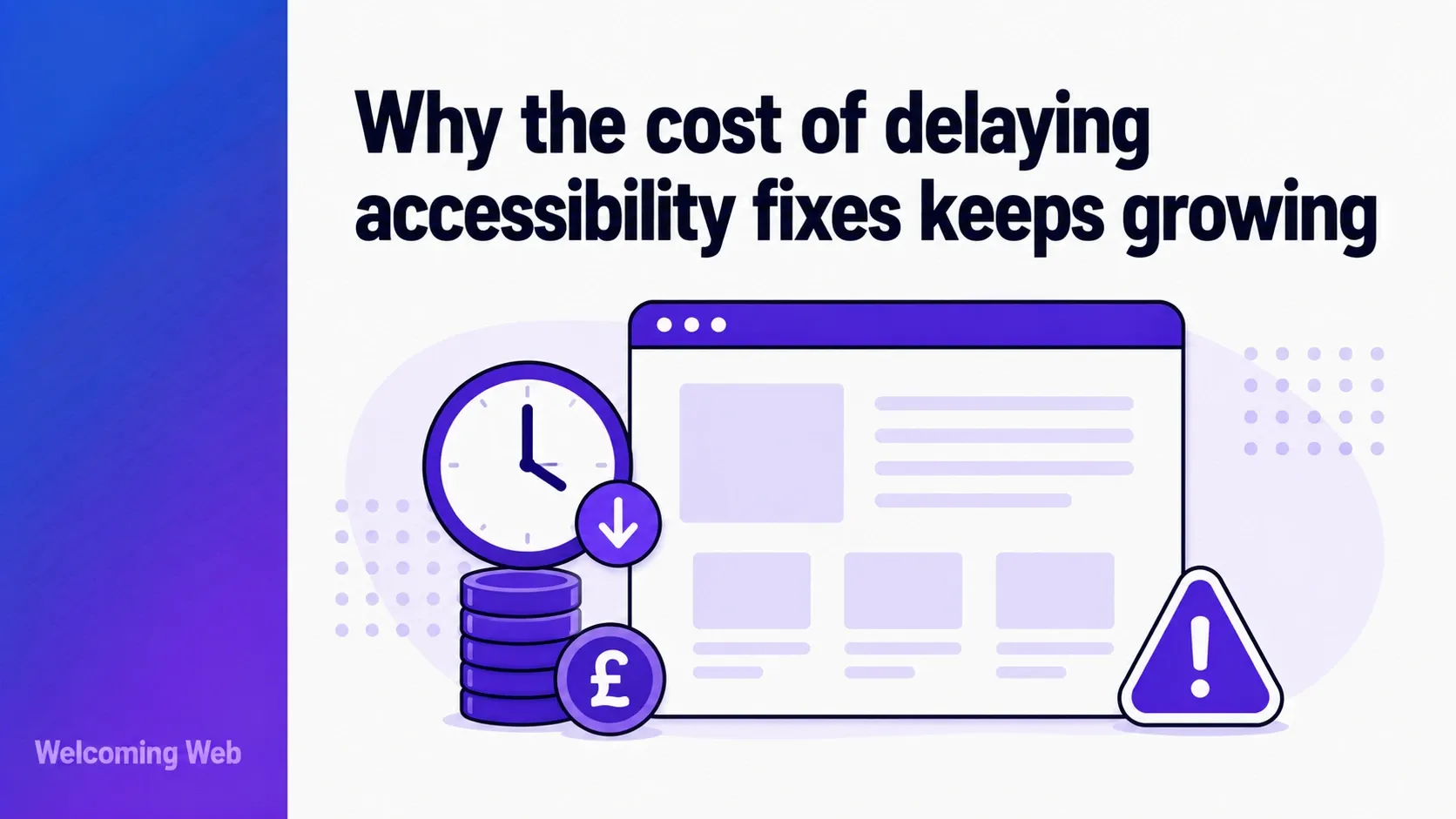
The cost of delaying accessibility fixes is rarely visible until it becomes unavoidable. Issues that are straightforward to address during development become significantly more costly after launch, as inaccessible decisions propagate across templates, components, and content. This piece covers why the cost of delaying accessibility fixes compounds, where it accumulates fastest, and what addressing them proactively costs compared to reactive remediation.
What is the cost of delaying accessibility fixes?
The cost of delaying accessibility fixes operates on three levels simultaneously: technical debt that grows as inaccessible decisions propagate, legal exposure that accumulates as the site remains live with known barriers, and reputational damage that builds as more users encounter an experience that does not work for them. Understanding all three is the starting point for making a credible internal case for addressing accessibility sooner.
The core technical reason is architectural. During development, accessibility is built into decisions that affect everything: the component library, the template structure, the heading hierarchy, the colour system, and the form patterns. Addressing these at the design and development stage means changing a decision once, before it propagates across the entire site.
After launch, the same fix affects every page, every component instance, and every piece of content built on top of the original decision. A heading structure built incorrectly into a page template requires a template change that then needs to be tested, deployed, and verified across every page that uses that template. A colour contrast failure in the primary text colour requires a design token change that affects every element using that colour across the entire site.
IBM's Systems Sciences Institute research on software defect costs established that fixing a defect in production costs significantly more than fixing the same defect during design or development. The cost of delaying accessibility fixes follows exactly the same pattern: issues caught before launch are configuration changes. The same issues caught after launch are remediation projects.
What does accessibility remediation cost?
The cost of remediating accessibility issues after launch varies significantly depending on the size and complexity of the site, the severity of the issues, and whether they are content-level or structural.
Content-level fixes such as missing alt text, non-descriptive link text, and missing page titles are lower cost regardless of when they are addressed, because they involve editing existing content rather than changing the underlying code. The cost scales with the number of pages affected.
Structural fixes are where the cost of delaying accessibility fixes compounds most dramatically. According to the Bureau of Labor Statistics, web developers in the US earn between $39 and $52 per hour on average. A keyboard navigation failure in a custom component might take a developer two hours to fix during development. The same fix after launch involves identifying the component, understanding its dependencies, writing the fix, testing it across browsers and assistive technologies, deploying it, and verifying it in production. That two-hour fix can become a half-day project or even longer.
At scale, industry analysis of accessibility remediation projects suggests a simple marketing website of 20 to 50 pages typically requires $5,000 to $20,000 in remediation work when issues are addressed after launch. Enterprise applications and ecommerce platforms with complex interactive components can run to $200,000 or more. The equivalent work during development represents a fraction of those figures.
How does legal risk add to the cost of delaying accessibility fixes?
Every day that accessibility issues remain unaddressed on a live website is another day of legal exposure. ADA Title III litigation has increased year on year, and a website with known accessibility barriers is a target regardless of whether the organisation has received a demand letter.
According to Seyfarth Shaw, 3,117 federal website accessibility lawsuits were filed in 2025, a 27% increase from 2024. Defending and settling an ADA lawsuit costs significantly more than the accessibility fixes that would have prevented it:
- Legal defence fees, which begin accumulating from the moment litigation is filed.
- Settlement costs, which typically run from a few thousand dollars for small businesses to hundreds of thousands for larger organisations.
- A court order requiring remediation, which still has to happen regardless of the legal outcome.
- Operational disruption from a court-imposed timeline rather than one the organisation controls.
An organisation that delays fixing accessibility issues does not avoid the remediation cost. It pays the remediation cost plus every item on that list.
For organisations in the EU, the European Accessibility Act became enforceable in June 2025. The Carrefour case in France, which resulted in a court order requiring full accessibility remediation within six months, illustrates that enforcement produces the same outcome as proactive remediation, but with a fixed deadline and the additional cost of legal proceedings attached.
What is the reputational cost of delaying accessibility fixes?
Reputational cost is harder to quantify than legal cost but no less real. Accessibility is becoming a customer expectation, and disabled consumers are increasingly vocal about which brands fall short. A 2024 Samsung UK survey found that 72% of disabled adults had abandoned a purchase due to a product's lack of accessibility, and 80% believe major brands are missing out on significant revenue by not thinking about inclusive design.
The longer accessibility issues remain on a live site, the larger the audience that encounters them. An organisation that addresses accessibility during development never creates that exposure. An organisation that delays creates a window during which every visitor with access needs experiences a brand that does not work for them, and increasingly shares that experience publicly.
Where does the cost of delaying accessibility fixes accumulate fastest?
Some accessibility issues compound faster than others, and the cost of delaying accessibility fixes is not evenly distributed across a site. Understanding where it accumulates most rapidly helps teams prioritise what to address first when developer time is limited. The four areas below are where unchecked accessibility debt tends to grow fastest.
Component libraries and design systems. An inaccessible component that is used across the site multiplies the problem with every new page that uses it. A button component with no keyboard event handling creates a keyboard accessibility failure on every page where that button appears. Fixing the component fixes every instance simultaneously, but the longer it sits unfixed, the more instances exist and the more thorough the testing needs to be after the fix.
CMS templates. A heading hierarchy problem built into a page template affects every page created from that template. The problem grows with every piece of content published. A template fixed early is a template fixed once.
Third-party integrations. Booking tools, chat widgets, payment processors, and embedded forms are often inaccessible and outside the organisation's direct control. The longer they are in place, the more entrenched they become and the more complex the replacement or remediation conversation with the vendor.
Content at scale. Missing alt text on a site with 500 product images is a different remediation task to missing alt text on a site with 50,000 product images. The content-level debt grows directly with the volume of content published while the issue is unaddressed.
What does proactive accessibility cost compared to reactive remediation?
The financial case for addressing accessibility earlier rather than later becomes clear when the two paths are compared directly.
Proactive accessibility, built in during design and development, adds time and cost to the initial build. Industry estimates for teams new to accessibility typically run to 10 to 30 percent of the development budget. For teams with established accessible component libraries and design systems, the overhead reduces significantly with each subsequent project.
Reactive remediation after a legal notice arrives is a different calculation entirely. The organisation pays a higher remediation cost because the issues have propagated, plus legal fees, settlement costs, and operates under a court-imposed timeline. The cost of delaying accessibility fixes ultimately increases the work required and adds costs on top.
Welcoming Web supports organisations in identifying and addressing accessibility issues before they compound. Scanning tools check pages against WCAG 2.2, ADA Title III, EN 301 549, and UK Equality Act standards, producing a prioritised issue list that shows where the most critical failures are and how severe each one is. AI-assisted remediation generates suggested fixes for supported issue types that teams can review and approve before anything changes. The dashboard tracks whether issues are new, fixed, or reappearing, giving teams a dated record of active remediation effort.
A free accessibility scan takes 60 seconds and gives you a concrete picture of the accessibility debt currently sitting on your site.
The longer you wait, the more accessibility fixes cost
Accessibility debt does not sit still. Every feature shipped, every page published, and every day a site remains live with known barriers adds to the cost of addressing it. Technical debt propagates. Legal exposure accumulates. Reputational damage builds with every user who encounters an experience that does not work for them.
The organisations that spend the least on accessibility are those that address it before it compounds into a remediation project, a legal notice, or both. For most sites, that compounding is already underway.
Get a free accessibility scan with Welcoming Web to see a clear picture of where your site currently stands and what addressing it now would involve.

Written by
Alisan Erdemli
CEO at Welcoming Web, and web accessibility technology expert
Connect on LinkedInReady to Make Your Website Accessible?
Join thousands of satisfied users who trust WelcomingWeb to deliver fully accessible, compliant, and inclusive digital experiences.