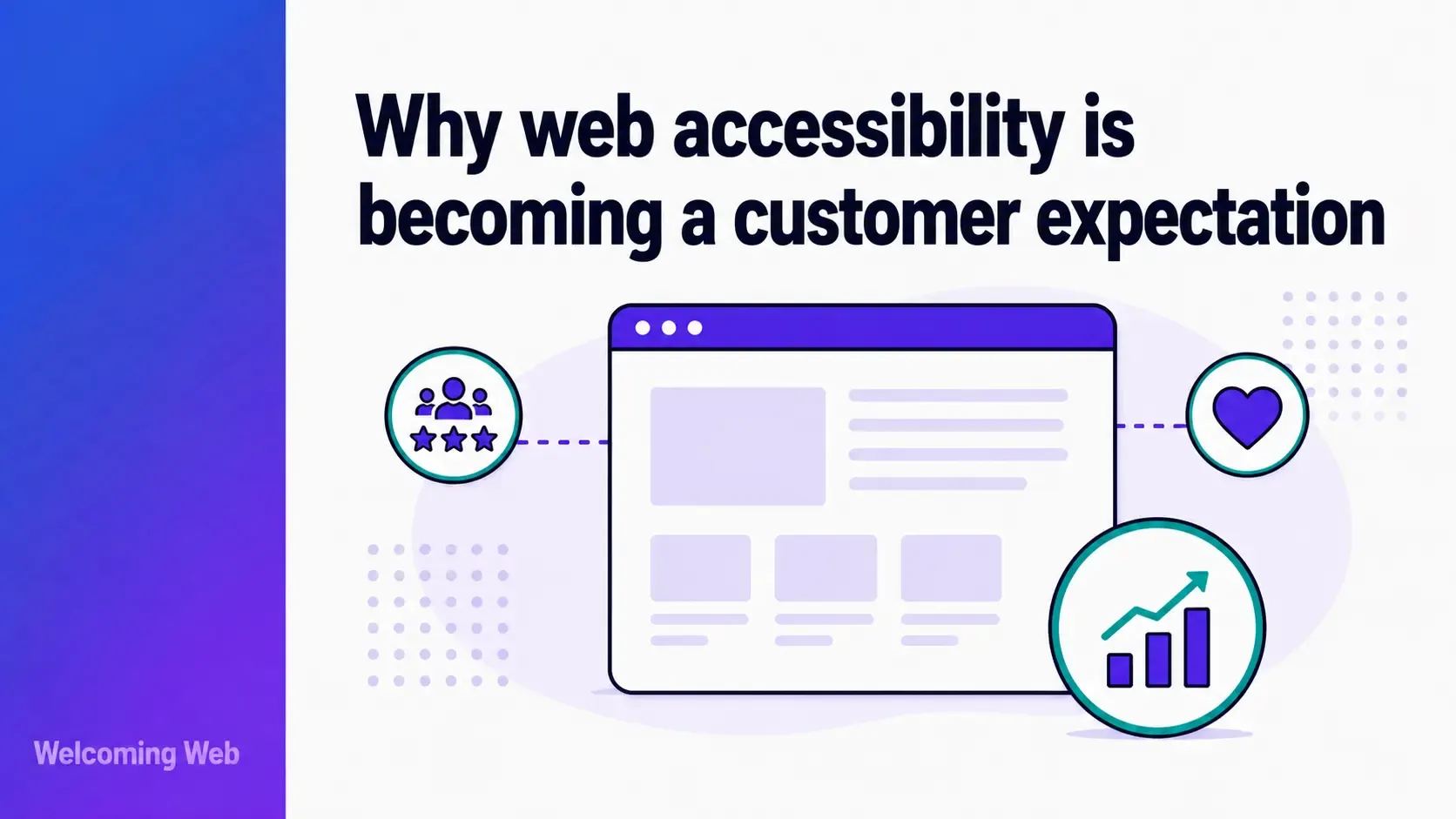
Web accessibility is becoming a customer expectation because disabled consumers are increasingly vocal, legal enforcement is accelerating, and a generation of consumers now expects inclusion as a baseline brand value. The customer expectation around accessibility has moved ahead of where most organisations have followed. This piece covers what is driving that shift, what the data says about purchasing behaviour and loyalty, and what it means for brands.
What has changed in how customers think about accessibility?
Customer expectations around web accessibility have shifted significantly over the past five years, driven by growing public awareness of disability inclusion, accelerating compliance monitoring requirements across major markets, and increasing visibility of disabled people in media, advocacy, and consumer communities.
A 2024 Samsung UK survey of 1,000 adults with visible and invisible disabilities found that 55% do not believe mainstream brands are invested enough in making products that cater to their needs, and 54% do not think companies understand which accessibility features matter to them. These are mainstream expectations going unmet.
The same survey found that 80% of respondents believe major brands are missing out on significant revenue by not thinking about inclusive design. Customers with disabilities are aware of the gap and are forming brand opinions based on it.
How does inaccessibility affect brand perception?
Inaccessibility is no longer experienced in silence. Disabled consumers, advocates, and communities are increasingly vocal about which brands get accessibility right and which do not. Social media has given those voices reach that did not exist a decade ago. A screen reader user who cannot complete a purchase on a major retailer's website has an audience for that experience in a way they simply did not before.
The Disability Belongs nonprofit reported in June 2026 that 90% of disabled consumers report being affected at the decision-making stage by inaccessible design, unclear information, or poor presentation of content. That figure represents a systematic failure of brand experience across the market.
According to the World Economic Forum, 92% of consumers are more likely to support companies that actively hire and support individuals with disabilities. The signal reflects whether a brand's values are visible in how it designs its products and services. Accessibility is one of the most tangible ways those values show up or fail to. For organisations that have not caught up with the customer expectation around inclusion, the reputational cost is increasingly measurable.
Is accessibility following the same path as mobile responsiveness?
Web accessibility is tracking a trajectory that mobile responsiveness followed a decade earlier. In 2010, mobile responsiveness was optional and most businesses ignored it. By 2015, Google began penalising non-mobile sites in search rankings. By 2018, a non-responsive website was considered a fundamental failure. Today, no serious business would launch a website that did not work on a phone.
The forces driving accessibility are different from those that drove mobile. Mobile responsiveness became an expectation primarily through search engine pressure. Accessibility is becoming a customer expectation through legal enforcement, demographic reality, and cultural shift.
The EAA became enforceable in June 2025. ADA litigation has increased year on year for the better part of a decade. An ageing global population means the proportion of users who rely on accessibility features is growing. And the generation of consumers now entering peak spending years grew up with diversity and inclusion as explicit values.
What does the data say about loyalty and willingness to pay?
The Samsung UK survey produced findings that challenge the assumption that accessibility is purely a cost or compliance issue. They also illustrate how clearly the customer expectation around accessibility is reflected in actual purchasing behaviour. Of the 1,000 disabled adults surveyed:
- 76% said they would stay loyal to companies offering a good range of accessible options
- 56% said they would pay more for a fully accessible product
- 72% had abandoned a purchase due to a product's lack of accessibility
A customer segment that is willing to pay a premium and demonstrates strong loyalty is commercially significant, and the market behind it is substantial. When the spending power of disabled individuals and their households is included, the figure runs to £274 billion annually in the UK alone, according to the same Samsung research.
Who else is affected by a brand's accessibility position?
The customer expectation around accessibility is shaped by a much wider group than users who rely on assistive technology. Disability Belongs reported in June 2026 that a single inaccessible experience ripples through an entire network of customers and influencers. A disabled user's household, carer, and wider community are all part of the purchasing decision.
Research from TriplePundit published in December 2025 estimated the global disability economy at $23 trillion, accounting for direct spending, family networks, and the broader community of people who choose brands based on their values around inclusion. That figure captures the full network effect of a brand's reputation for accessibility.
A brand's accessibility position is evaluated by users who rely on assistive technology, the people around them, consumers who read reviews, and a public that is increasingly attuned to whether brands live their stated values.
How is B2B procurement reflecting accessibility expectations?
The customer expectation around accessibility has moved into B2B markets as well as consumer ones. Public sector organisations in the UK, EU, and US are required by law to procure accessible digital products and services. The UK Public Sector Bodies Accessibility Regulations and the US Section 508 of the Rehabilitation Act both require that software and services purchased with public funds meet WCAG 2.1 Level AA. Any software vendor, SaaS product, or digital agency that cannot demonstrate accessibility compliance is excluded from those contracts.
In the private sector, enterprise procurement processes are increasingly including accessibility assessments as standard. Legal teams are aware of ADA and EAA exposure. Compliance officers are asking vendors to produce accessibility documentation before signing contracts. The expectation is spreading from regulated sectors into general commercial procurement.
How should organisations respond to the shift in accessibility expectations?
Most organisations that have engaged with accessibility at all have done so through a compliance lens, treating it as a risk to manage. That framing creates a minimum bar mentality where the goal is to do enough to avoid consequences. It is increasingly out of step with the customer expectation that accessibility is a baseline standard.
The customer expectation framing changes the question. The goal shifts from avoiding a complaint to ensuring the website works for the full range of people trying to use it. That is a more honest question and, increasingly, the one customers are asking on behalf of brands that are not asking it themselves.
Welcoming Web supports organisations in building a documented, ongoing accessibility programme. Scanning tools check pages against WCAG 2.2, ADA Title III, EN 301 549, and UK Equality Act standards. The dashboard tracks whether issues are new, fixed, or reappearing. Reports can be exported for compliance documentation, developer handover, or procurement requirements. The visitor-facing accessibility widget gives every user direct control over how the site looks and behaves for them from the moment it is installed.
Accessibility has already become a customer expectation
Customers with disabilities are forming opinions about brands based on whether their digital experiences work. The customer expectation that a website should be accessible is no longer limited to specialist communities. Those opinions are increasingly public, the legal environment is tightening, and procurement requirements are rising.
Organisations that treat accessibility as a compliance checkbox are already behind. Run a free accessibility scan with Welcoming Web to identify where your site currently stands.

Written by
Alisan Erdemli
CEO at Welcoming Web, and web accessibility technology expert
Connect on LinkedInReady to Make Your Website Accessible?
Join thousands of satisfied users who trust WelcomingWeb to deliver fully accessible, compliant, and inclusive digital experiences.