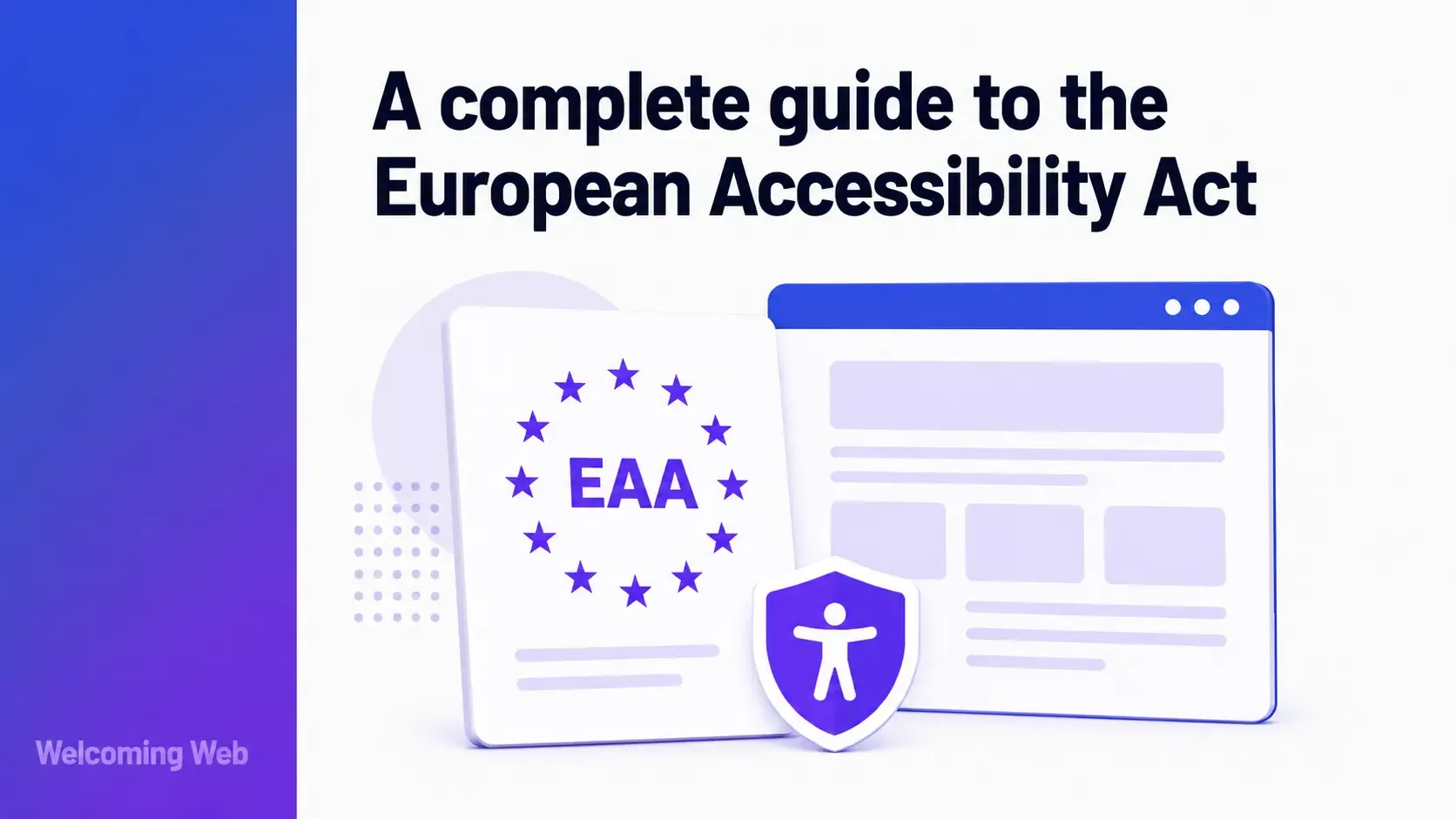
The European Accessibility Act (EAA) is an EU directive that became enforceable in 2025, requiring any organisation providing products or services to EU consumers to meet specific accessibility standards. For websites and digital services, this means conforming to WCAG 2.1 Level AA via the EN 301 549 standard. This guide covers what the EAA requires, who it applies to, what enforcement looks like, and how to work toward compliance.
What is the European Accessibility Act?
The European Accessibility Act, formally Directive (EU) 2019/882, is EU legislation requiring accessibility for a wide range of consumer-facing products and services across all 27 EU member states. It was adopted in 2019 and gave organisations a three-year transition period to prepare. Enforcement began on 28 June 2025, making compliance monitoring an obligation for any organisation serving EU consumers.
The EAA is a directive rather than a regulation, which means it required each EU member state to transpose its requirements into national law by June 2025. All 27 member states completed transposition, though the specific enforcement mechanisms, penalty structures, and enforcement agencies differ by country. The underlying accessibility obligations are harmonised across the EU.
The EAA's stated aim, drawn from the Directive itself, is to address the fragmented accessibility landscape across the EU and ensure that people with disabilities can access the same products and services as everyone else. The European Commission estimates that approximately 87 million people in the EU live with a disability, representing a significant portion of the population that consumer-facing organisations have a legal obligation to serve.
Who does the European Accessibility Act apply to?
The EAA applies to any organisation placing covered products on the EU market or providing covered services to EU consumers, regardless of where the organisation is based. A US company, a UK company, or an Australian company selling or providing covered services to EU customers is subject to the EAA.
What products and services does the EAA cover?
For digital products and services, the EAA covers:
- E-commerce websites and platforms selling goods or services to EU consumers.
- Banking and financial services provided digitally, including online banking and payment services.
- Electronic communications services and related consumer equipment.
- Transport services including ticketing, travel information, and booking platforms.
- E-books and e-readers.
- Streaming and on-demand audiovisual media services.
- Operating systems and consumer hardware with interactive digital interfaces
The EAA's coverage of e-commerce is particularly broad. Any website that allows EU consumers to browse, select, and purchase products or services falls within scope. This includes organisations that primarily trade in a non-EU market but also sell to EU customers through the same platform.
Does the EAA apply to organisations based outside the EU?
The EAA applies based on where the service is offered and consumed, not where the organisation is headquartered. An organisation serving EU customers through a website or digital service faces EAA obligations regardless of where it is incorporated or where its servers are located. This mirrors the extraterritorial reach of GDPR, which the EAA was designed to complement.
Is there an exemption for small businesses?
The EAA includes a micro-enterprise exemption for service providers. Organisations with fewer than ten employees and annual turnover or balance sheet total not exceeding €2 million are exempt from the EAA's service provider obligations. This exemption applies to service providers only. Product manufacturers must comply regardless of size.
What are the technical requirements of the European Accessibility Act?
The EAA does not specify its own technical accessibility requirements in detail. It references EN 301 549, a harmonised European standard published by ETSI (the European Telecommunications Standards Institute), as the technical benchmark organisations must meet.
EN 301 549 incorporates WCAG 2.1 Level AA as the standard for web content and mobile applications. In practice, this means that an organisation whose website meets WCAG 2.1 Level AA is meeting the technical requirements of the EAA for web content.
WCAG 2.1 Level AA requires websites to meet success criteria across four principles: Perceivable (content must be available to all senses users rely on), Operable (all functionality must work without a mouse), Understandable (content and interfaces must be clear and consistent), and Robust (content must work reliably with current and future assistive technologies).
Beyond web content, the EAA also requires organisations to:
- Publish an accessibility statement describing the accessibility of their products or services, known barriers, and how users can report problems.
- Provide a feedback mechanism allowing users to request information in an accessible format.
- Maintain documentation demonstrating that their products or services meet the required accessibility standards.
How is the European Accessibility Act being enforced?
Enforcement of the EAA is carried out by national market surveillance and enforcement authorities in each EU member state, with different agencies responsible for different sectors. Understanding how enforcement is developing gives organisations a realistic picture of the current risk landscape.
What has happened since EAA enforcement began?
France saw the first EAA enforcement actions. On 7 July 2025, French disability organisations sent formal legal notices to four major retailers (Auchan, Carrefour, E.Leclerc, and Picard) citing systematic accessibility failures on their e-commerce platforms including missing alternative text, keyboard navigation failures, and inaccessible checkout flows. When responses proved inadequate, emergency injunctions were filed in the Tribunal judiciaire de Paris in November 2025. In June 2026, the Carrefour case produced a significant ruling: the court ordered Carrefour to make both its e-commerce site and mobile application fully accessible within six months, under daily financial penalties for each day of delay.
In Germany, private warning letters citing accessibility violations began arriving at e-commerce operators within weeks of the EAA transposition taking effect in August 2025. These letters were sent by law firms using Germany's competition law framework, under which non-compliance with accessibility obligations can be pursued as an unfair trading practice, independently of the formal regulatory enforcement route.
Sweden's Post and Telecom Authority (PTS) began systematic inspections of e-commerce platforms and received 124 public complaints in its first months of enforcement activity. The Netherlands' Authority for Consumers and Markets (ACM) sent information requests to e-commerce operators including companies headquartered outside the EU, signalling that extraterritorial reach is being actively applied.
What EAA enforcement action has taken place so far?
As of June 2026, no confirmed financial penalties had been publicly reported as having been issued specifically under national laws implementing the EAA. The Carrefour court order in France represents the most significant enforcement outcome to date, but formal regulatory fines with confirmed amounts have not yet been applied.
This does not mean the risk is low. Private litigation in France, competition law enforcement in Germany, and formal investigation programmes in Sweden and the Netherlands all represent active enforcement activity. The absence of confirmed fines reflects the early stage of enforcement rather than a lack of regulatory appetite.
What are the financial consequences of EAA non-compliance?
The EAA requires penalties to be effective, proportionate, and dissuasive, but leaves the specific amounts to each member state. Confirmed penalty structures from primary sources include:
- Germany: up to €100,000 per violation under the BFSG (Barrierefreiheitsstärkungsgesetz)
- France: up to €250,000 for repeated violations, with lower base penalties for single violations
- Netherlands: up to €900,000 or 10% of annual revenue under ACM enforcement powers
- Ireland: up to €60,000, with the additional distinction of being the only EU member state with criminal sanctions for deliberate and sustained non-compliance
Financial penalties are not the only risk. Authorities can order product withdrawal, ban non-compliant products or services from national markets, require accessibility audits at the organisation's expense, and publicly name organisations that fall short. In Germany, competitors can pursue non-compliance as an unfair competition claim independently of regulatory action.
Does the European Accessibility Act apply to existing websites?
The EAA applies to websites and digital services that are currently in operation as of 28 June 2025. There is no grace period for websites that were already live when enforcement began. The transition period that ended on 28 June 2025 was the grace period. Organisations were expected to use the three years between the Directive's adoption in 2019 and enforcement to prepare.
Some limited exceptions apply to specific product categories. Self-service terminals (such as ATMs and ticketing machines) that were already deployed before 28 June 2025 have until 28 June 2030 to be replaced with compliant versions. This exception applies to hardware only, not to the digital services accessed through them.
How does the European Accessibility Act relate to other accessibility laws?
The EAA sits alongside other accessibility frameworks that organisations may already be familiar with, and understanding the relationship between them helps avoid duplication of effort.
WCAG 2.1 Level AA is the technical standard that both the EAA (via EN 301 549) and the ADA (via DOJ guidance and court precedent) reference as the benchmark for web accessibility. Organisations that have already worked toward WCAG 2.1 Level AA conformance for ADA purposes are, in most respects, also addressing their EAA technical obligations.
The Web Accessibility Directive (Directive 2016/2102) is a separate EU directive that applies specifically to public sector websites and mobile applications. It has been in force since 2018 and requires WCAG 2.1 Level AA conformance and published accessibility statements for public sector bodies. The EAA extends similar obligations to the private sector. Both directives reference EN 301 549 as their technical standard.
The UK Equality Act 2010 requires organisations in the UK to make reasonable adjustments for disabled people accessing their services. UK organisations serving EU customers face EAA obligations in addition to their domestic Equality Act obligations.
How does Welcoming Web support EAA compliance?
Welcoming Web scans pages against WCAG 2.2, ADA Title III, EN 301 549, and UK Equality Act 2010 standards. Since WCAG 2.2 is backward compatible with WCAG 2.1, a scan against WCAG 2.2 covers all WCAG 2.1 Level AA criteria (the technical requirement underpinning EAA website compliance). Each issue identified is linked to the specific criterion it relates to and grouped by severity in the dashboard.
The dashboard tracks whether issues are new, fixed, or reappearing between scans, giving teams a dated record of accessibility work that can be exported in PDF or CSV format. This documentation serves as evidence of active good faith effort and is the kind of record that carries weight when complaints are made or regulatory investigations begin.
Welcoming Web does not certify EAA compliance and does not provide legal advice. What it provides is a documented, exportable record of accessibility scanning and remediation work against the standards the EAA references.
A free accessibility scan takes 60 seconds and gives you a prioritised view of where your site stands against EN 301 549 and WCAG 2.1 Level AA requirements.
European Accessibility Act: what to take away
The European Accessibility Act is enforceable law. Enforcement is active in France, Germany, Sweden, and the Netherlands, and the direction across all 27 member states is consistent. Organisations that serve EU consumers through a website or digital service face genuine legal exposure if they have not addressed their EAA obligations.
The technical starting point is WCAG 2.1 Level AA, the standard EN 301 549 incorporates for web content. Conduct a free accessibility scan with Welcoming Web today and get a prioritised picture of where your site currently stands against those requirements.

Written by
Alisan Erdemli
CEO at Welcoming Web, and web accessibility technology expert
Connect on LinkedInReady to Make Your Website Accessible?
Join thousands of satisfied users who trust WelcomingWeb to deliver fully accessible, compliant, and inclusive digital experiences.