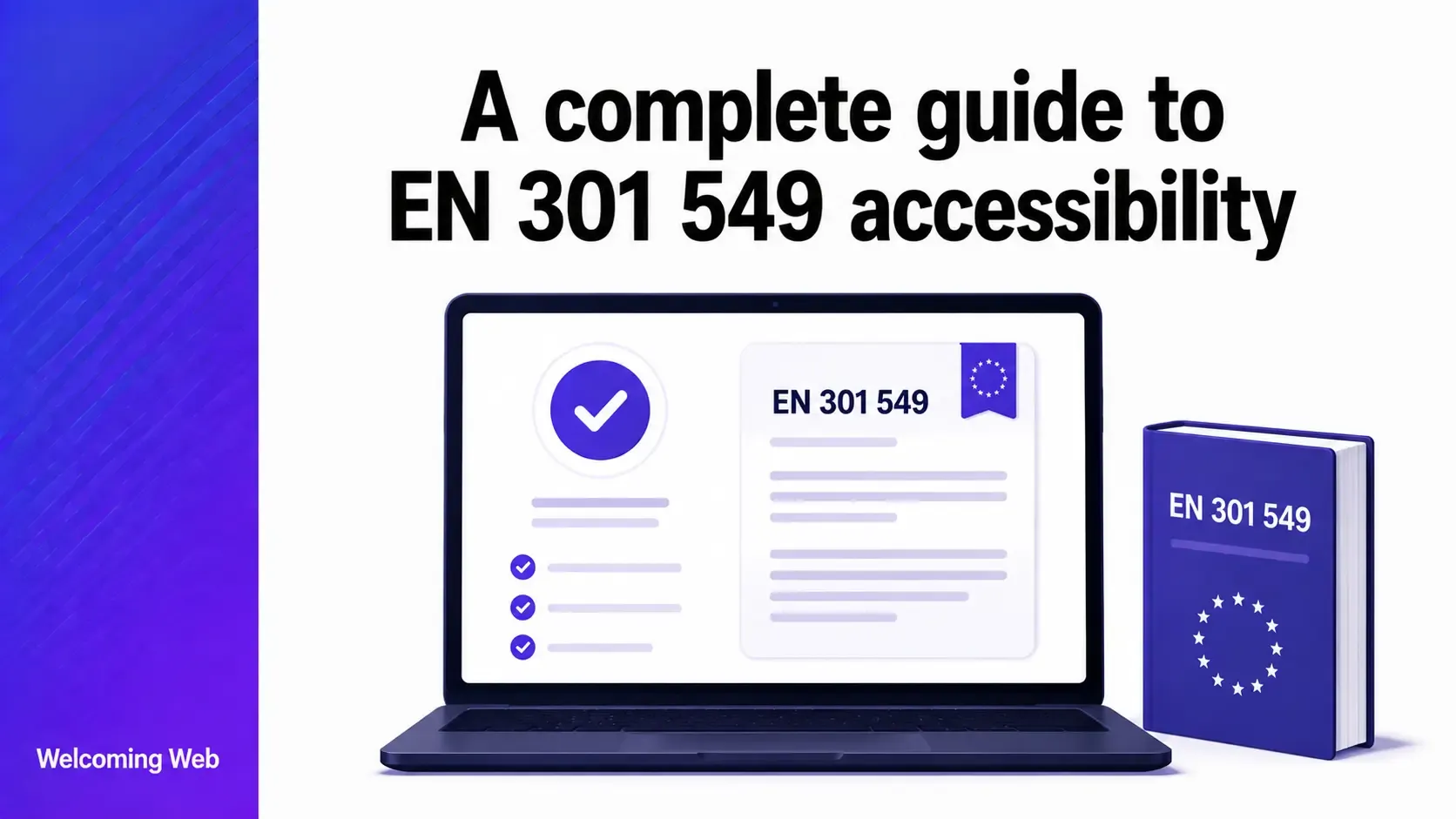
EN 301 549 is the harmonised European standard for ICT accessibility, published by ETSI in cooperation with CEN and CENELEC. It turns the legal obligations of the European Accessibility Act and the Web Accessibility Directive into specific, testable requirements. For web content this means WCAG 2.1 Level AA. This guide covers what EN 301 549 requires, how it is structured, and who needs to conform.
What is EN 301 549?
EN 301 549, formally titled Accessibility Requirements for ICT Products and Services, was first published in February 2014 by CEN, CENELEC, and ETSI to establish a single, harmonised technical framework for ICT accessibility across the EU. ICT, or Information and Communication Technology, covers websites, mobile applications, software, electronic documents, hardware, and telecommunications equipment. The current version is V3.2.1, published in March 2021 and referenced in the Official Journal of the EU on 18 August 2021 via Implementing Decision (EU) 2021/1339.
The standard covers a wide range of ICT products and services: websites, mobile applications, non-web software, electronic documents, hardware, and telecommunications equipment. Its purpose is to define what accessibility means in technical terms for each of these product types, so that organisations, procurers, and regulators have a consistent, testable reference point for assessing whether a product or service is accessible.
EN 301 549 is a harmonised standard, which means it has been cited in the Official Journal of the EU and carries legal presumption of conformance with the accessibility requirements of the directives that reference it. An organisation that demonstrates conformance with EN 301 549 is presumed to meet the accessibility requirements of the EAA and the Web Accessibility Directive for the scope of products and services covered.
How does EN 301 549 relate to WCAG?
The relationship between EN 301 549 and WCAG is often misunderstood. EN 301 549 does not replace WCAG or exist independently of it. For web content specifically, Chapter 9 of EN 301 549 incorporates WCAG 2.1 Level A and AA in their entirety. An organisation whose website conforms to WCAG 2.1 Level AA automatically satisfies the web content requirements of EN 301 549.
The value EN 301 549 adds is scope. WCAG was designed specifically for web content. EN 301 549 uses WCAG as the foundation for web requirements and then applies equivalent accessibility principles to non-web contexts, covering desktop and mobile applications in Chapter 11, non-web documents such as PDFs and office files in Chapter 10, and hardware in the chapters covering physical ICT products.
The relationship can be summarised as: WCAG defines web accessibility. EN 301 549 incorporates WCAG for web content and extends similar principles to everything else an organisation might produce or procure in the ICT space.
How is EN 301 549 structured?
EN 301 549 V3.2.1 is organised into chapters, each covering a specific category of ICT product or service. Understanding the chapter structure is the most useful starting point for any organisation trying to understand which parts of the standard apply to them. Chapters 4 to 13 cover the following:
- Chapter 4 contains functional performance statements that explain the functionality needed to enable users with different abilities to locate, identify, and operate ICT functions. These statements are the basis for the specific technical requirements in subsequent chapters.
- Chapter 5 covers generic requirements that apply across all ICT product types, including closed functionality, biometrics, and preservation of accessibility information during conversion.
- Chapter 6 covers ICT with two-way voice communication, including audio bandwidth requirements, real-time text functionality, and video communication requirements.
- Chapter 7 covers ICT with video capabilities, including subtitle processing and audio description requirements.
- Chapter 8 covers hardware, including physical characteristics such as operable parts, reach ranges, and display requirements for stationary ICT products.
- Chapter 9 covers web content and incorporates WCAG 2.1 Level A and AA in their entirety. For organisations working on websites and web applications, Chapter 9 is the primary point of reference. Conforming to WCAG 2.1 Level AA satisfies Chapter 9.
- Chapter 10 covers non-web documents, including PDFs, Word documents, PowerPoint presentations, and other file formats not delivered through a browser. The requirements in Chapter 10 apply WCAG's principles to documents, addressing how information, navigation, and interactive elements in documents need to be accessible.
- Chapter 11 covers non-web software, including desktop applications and mobile applications. It applies accessibility requirements to software that is not a website, covering keyboard accessibility, focus management, assistive technology compatibility, and user preferences for display and interaction.
- Chapter 12 covers documentation and support services, requiring that product documentation describing accessibility and compatibility features is itself accessible, and that support services can communicate effectively with users who rely on assistive technology.
- Chapter 13 covers ICT providing relay or emergency service access, with requirements for telecommunications products and services used to access emergency services.
How does EN 301 549 relate to the European Accessibility Act?
The EAA does not specify its own technical accessibility requirements in detail. Instead, it references EN 301 549 as the harmonised standard that organisations must meet to satisfy its requirements. The relationship is: the EAA is the law, EN 301 549 is the technical standard the law points to.
For web content and mobile applications, this means the EAA's technical requirements are WCAG 2.1 Level AA, because that is what Chapter 9 of EN 301 549 incorporates. For organisations that also provide non-web software, documents, or hardware to EU consumers, the relevant chapters of EN 301 549 covering those product types also apply.
The EAA became enforceable on 28 June 2025. At that point, EN 301 549 V3.2.1 was the cited harmonised standard. A revised version, currently in draft as V4.1.0 and expected to be published as V4.1.1, incorporates WCAG 2.2 in place of WCAG 2.1. The draft was published by ETSI in November 2025. Until the final version is referenced in the Official Journal of the EU, V3.2.1 remains the standard with legal presumption of conformance under the EAA. Organisations planning their accessibility programmes should target WCAG 2.2 Level AA, which is backward compatible with WCAG 2.1, to be prepared for the transition when it occurs.
How does EN 301 549 relate to the Web Accessibility Directive?
The Web Accessibility Directive, formally Directive (EU) 2016/2102, applies to public sector websites and mobile applications across EU member states. It entered into force in December 2016, with implementation deadlines for public sector websites in September 2019 for new sites and September 2020 for existing sites, and mobile applications in June 2021. Like the EAA, it references EN 301 549 as its harmonised technical standard, setting the same technical benchmark of WCAG 2.1 Level AA through Chapter 9.
The Web Accessibility Directive covers public sector bodies. The EAA extends the same obligations to the private sector, and also broadens the product scope to cover hardware, software, and services that the Web Accessibility Directive does not address. For public sector organisations already working toward Web Accessibility Directive compliance, the technical standard is unchanged. The EAA introduces new obligations in scope rather than in technical requirements.
Who does EN 301 549 apply to?
EN 301 549 applies to any organisation that places covered ICT products on the EU market or provides covered ICT services to EU consumers. The range of organisations affected is broad.
Public sector bodies across all 27 EU member states are required to conform with EN 301 549 for their websites and mobile applications under the Web Accessibility Directive. Public sector websites were required to comply from September 2020 for existing sites and September 2019 for new sites, with mobile applications following in June 2021.
Private sector organisations are required to conform with EN 301 549 under the EAA for the range of products and services covered by that directive, including ecommerce websites, banking and financial services, transport booking platforms, electronic communications services, and digital media. The EAA has been enforceable since 28 June 2025.
Organisations involved in public procurement are directly affected. EU public procurement rules require that ICT products and services purchased with public funds meet EN 301 549. Any technology vendor, software provider, or digital agency bidding for public sector contracts in the EU must be able to demonstrate conformance with the standard for the products and services they are supplying.
Any organisation selling or providing covered ICT products or services to EU consumers faces EN 301 549 obligations through the EAA, regardless of where it is headquartered. The standard applies based on where a service is offered and consumed.
How does Welcoming Web support EN 301 549 conformance?
Welcoming Web scans pages against WCAG 2.2, ADA Title III, EN 301 549, and UK Equality Act 2010 standards. Since WCAG 2.2 is backward compatible with WCAG 2.1, scanning against WCAG 2.2 covers all WCAG 2.1 Level AA criteria that form the basis of Chapter 9 of EN 301 549. Each issue identified is linked to the specific criterion it relates to and grouped by severity in the dashboard.
The Welcoming Web dashboard tracks whether issues are new, fixed, or reappearing between scans, giving teams a dated record of active accessibility work. Reports can be exported in PDF or CSV format for compliance documentation, procurement requirements, or developer handover. For organisations subject to EN 301 549 through the EAA or public procurement requirements, this documentation serves as evidence of active good faith conformance effort.
Welcoming Web does not certify EN 301 549 conformance and does not provide legal advice. What it provides is a documented, exportable record of scanning and remediation work against the standards that EN 301 549 incorporates for web content. A free accessibility scan takes 60 seconds and gives you a starting point for understanding where your web content currently stands against those requirements.
EN 301 549 is the technical backbone of EU accessibility law
EN 301 549 is the harmonised technical standard that gives the EAA and the Web Accessibility Directive their testable requirements. For web content, meeting WCAG 2.1 Level AA satisfies it. For organisations with broader ICT footprints, the chapters on non-web software, documents, and hardware define what accessibility means across the full range of digital products and services.
The transition to V4.1.1, which incorporates WCAG 2.2, is underway with a draft published in November 2025. Targeting WCAG 2.2 Level AA now is the most future-proof approach to EN 301 549 conformance, and the starting point for any organisation that has not yet assessed its accessibility position is a clear picture of where it currently stands. An accessibility scan with Welcoming Web takes 60 seconds and gives you that picture for your web content.

Written by
Alisan Erdemli
CEO at Welcoming Web, and web accessibility technology expert
Connect on LinkedInReady to Make Your Website Accessible?
Join thousands of satisfied users who trust WelcomingWeb to deliver fully accessible, compliant, and inclusive digital experiences.