A website accessibility consultant helps businesses identify and resolve barriers that prevent people with disabilities from using their websites. They assess accessibility against recognised standards, test how websites work with assistive technology, and advise teams on improvements. But does every business need to hire a specialist? In this guide, we'll explain what website accessibility consultants do, when professional support is worthwhile, and how accessibility software can help you manage improvements.
What is a website accessibility consultant?
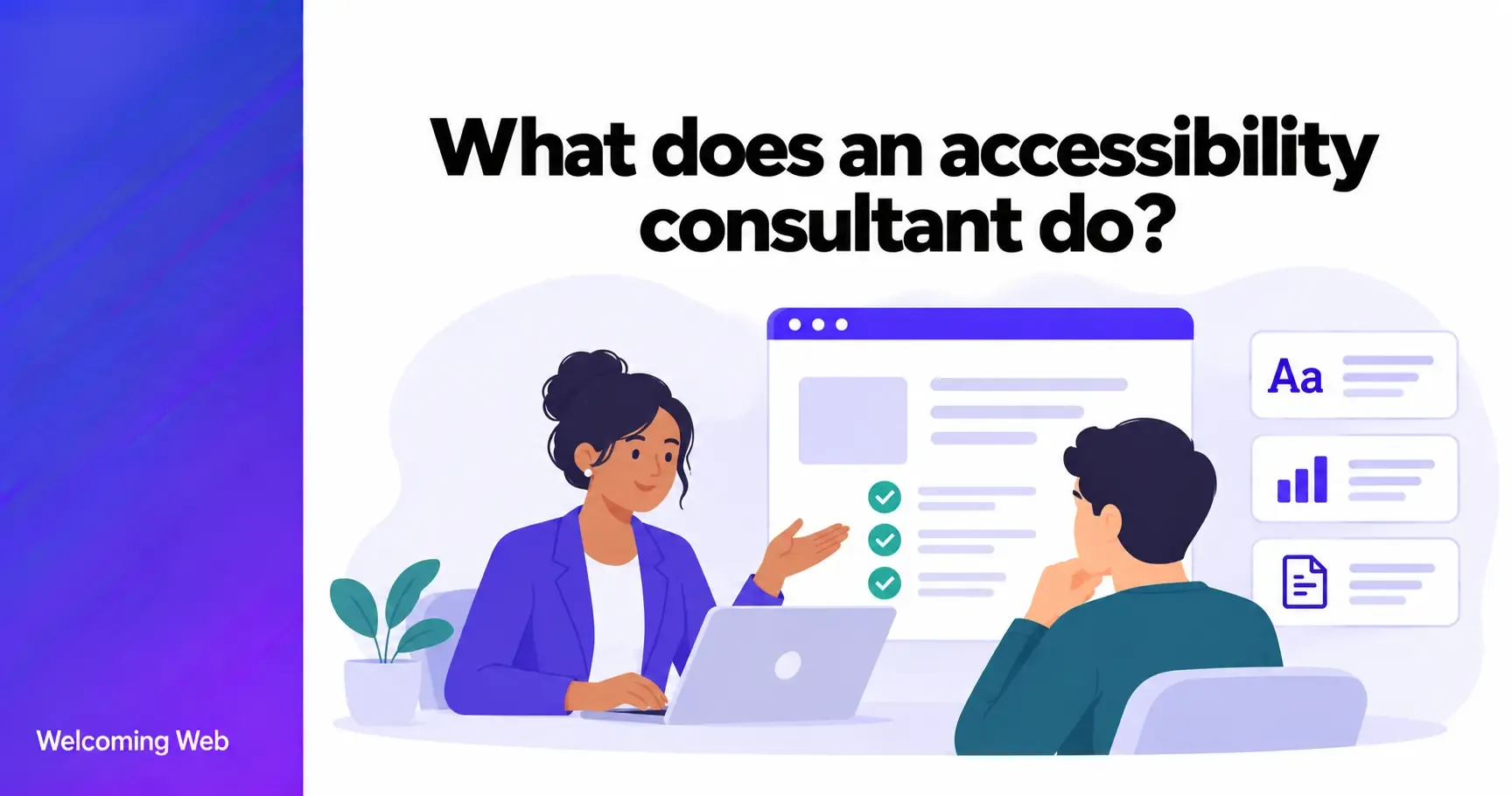
A website accessibility consultant is a specialist who helps organisations make their websites accessible to people with disabilities. They combine knowledge of web design, development, assistive technology, and accessibility standards to evaluate websites and recommend improvements.
Most web accessibility consultants work with the Web Content Accessibility Guidelines (WCAG), which provide internationally recognised criteria for making digital content more accessible. For example, a consultant might investigate why a screen reader cannot identify a form field, assess whether a checkout process works without a mouse, or advise developers on building accessible navigation.
Consultants may work independently, as part of an accessibility consultancy, or within a larger digital agency. Their responsibilities depend on the services they offer and the organisation's requirements.
What does a website accessibility consultant do?
Website accessibility consultants help businesses assess, improve, and maintain the accessibility of their websites. Their services can range from a one-off assessment to ongoing support with design, development, and accessibility management. Common services include:
- Website accessibility audits: Evaluating pages, templates, and interactive features against standards such as WCAG 2.2. Consultants typically provide a report identifying accessibility issues, their impact, and recommended fixes.
- Assistive technology testing: Checking how websites work with screen readers, keyboard navigation, voice control, and other assistive technologies to identify barriers that automated tools may miss.
- Remediation guidance: Helping developers and designers resolve accessibility problems, such as incorrectly labelled forms, inaccessible navigation, or poorly implemented interactive components. Some consultants also implement fixes directly.
- Design and development support: Reviewing wireframes, prototypes, and website components to help teams address accessibility requirements before new features are released.
- Accessibility training and planning: Training employees in accessible design, development, and content creation, while helping organisations establish processes for maintaining accessibility over time.
When should you hire a website accessibility consultant?
Hiring a website accessibility consultant can be worthwhile when your business needs specialist expertise or an independent assessment of its website. This is particularly useful when launching or redesigning a website, responding to accessibility complaints, or evaluating your website against standards such as WCAG 2.2.
Consultants can also help when your team encounters complex accessibility problems that it cannot resolve internally. For example, issues with keyboard navigation, screen reader compatibility, or interactive components may require detailed manual testing and technical guidance.
If your website has a large number of accessibility issues, a consultant can help prioritise improvements based on their impact on users. However, businesses with straightforward accessibility needs may be able to identify and address many supported issues using accessibility software and their existing development resources.
When can you use website accessibility software instead?
Website accessibility software like Welcoming Web's solutions can be a practical starting point for businesses that want to identify accessibility issues, make improvements internally, and monitor their websites without immediately hiring a consultant.
It can be particularly useful when:
- You want to identify common accessibility issues: Automated scans can detect supported problems, such as missing alternative text, certain colour contrast failures, and incorrectly labelled form fields.
- You regularly update your website: Ongoing monitoring can help identify new accessibility issues introduced through content changes, redesigns, or development updates.
- Your team can implement fixes: Accessibility reports and remediation suggestions can help developers and content editors investigate and address supported problems.
- You have a limited budget: Software can help you begin identifying issues and prioritising improvements before investing in specialist services.
Welcoming Web's accessibility compliance monitoring helps businesses scan websites for supported accessibility issues, review AI-assisted remediation suggestions, and track findings over time.
Automated tools cannot identify every accessibility barrier or replace manual testing. However, they can support ongoing accessibility work and help businesses determine where additional expertise may be needed.
How much does a website accessibility consultant cost?
Website accessibility consultant fees depend on the size and complexity of your website, the services required, and the amount of testing involved. Consultants may charge hourly or daily rates, offer fixed-price audits, or provide ongoing support through a retainer.
The type of service also affects the cost:
- Targeted accessibility reviews: Assess a specific page, component, or user journey.
- Comprehensive accessibility audits: Evaluate representative pages, templates, and interactive features against relevant accessibility standards.
- Remediation support: Provide technical guidance or implement accessibility fixes.
- Ongoing consulting: Offer regular testing, training, and advice as your website changes.
Before hiring a consultant, request a quote that clearly explains the scope of testing, reporting, remediation support, and any follow-up work. This makes it easier to compare providers and understand what you're paying for.
How to choose a website accessibility consultant
If you decide to hire a consultant, look for someone with relevant experience, a clear testing approach, and the ability to provide practical recommendations. Consider the following:
- Experience: Look for consultants who have worked with websites or applications similar to yours.
- Qualifications: Professional credentials from organisations such as the International Association of Accessibility Professionals (IAAP) can provide evidence of specialist knowledge.
- Testing methods: Confirm that their approach includes appropriate manual and assistive technology testing, rather than relying exclusively on automated scans.
- Reporting: Ask whether you'll receive a detailed report explaining the issues identified, their impact, and recommended fixes.
- Remediation support: Establish whether the consultant can help implement improvements or verify fixes after your team has completed them.
Before committing, make sure you understand which services are included in the quoted price and what your organisation will be responsible for completing.
Start improving your website accessibility
A website accessibility consultant can help when your business needs specialist testing, technical guidance, or an independent assessment. For routine checks and ongoing monitoring, accessibility software can provide a more accessible starting point.
Welcoming Web helps businesses identify supported accessibility issues, review AI-assisted remediation suggestions, and monitor their websites as they change. Run a free accessibility scan today to identify potential barriers and start planning improvements.

Written by
Alisan Erdemli
CEO at Welcoming Web, and web accessibility technology expert
Connect on LinkedInReady to Make Your Website Accessible?
Join thousands of satisfied users who trust WelcomingWeb to deliver fully accessible, compliant, and inclusive digital experiences.