AI for accessibility is changing how teams move from identifying website barriers to fixing them. AI can analyse supported findings, generate remediation suggestions, and reduce repetitive work across larger websites. This guide explains how AI supports website accessibility remediation, where it works best, and how teams can use it effectively.
What is accessibility remediation?
Accessibility remediation is the process of correcting barriers that prevent people with disabilities from accessing or using digital content. For websites, this can involve changes to content, code, design, and interactions.
An accessibility scan, manual audit, or other evaluation can identify a potential barrier. Remediation deals with what happens next: determining the appropriate correction and putting it in place.
This separates accessibility testing from accessibility remediation. A website can have a detailed accessibility report while still having a substantial backlog of unresolved issues.
Where does AI fit into accessibility remediation?
Traditional automated accessibility testing focuses primarily on detection. A tool evaluates supported aspects of a page and reports findings for someone to investigate.
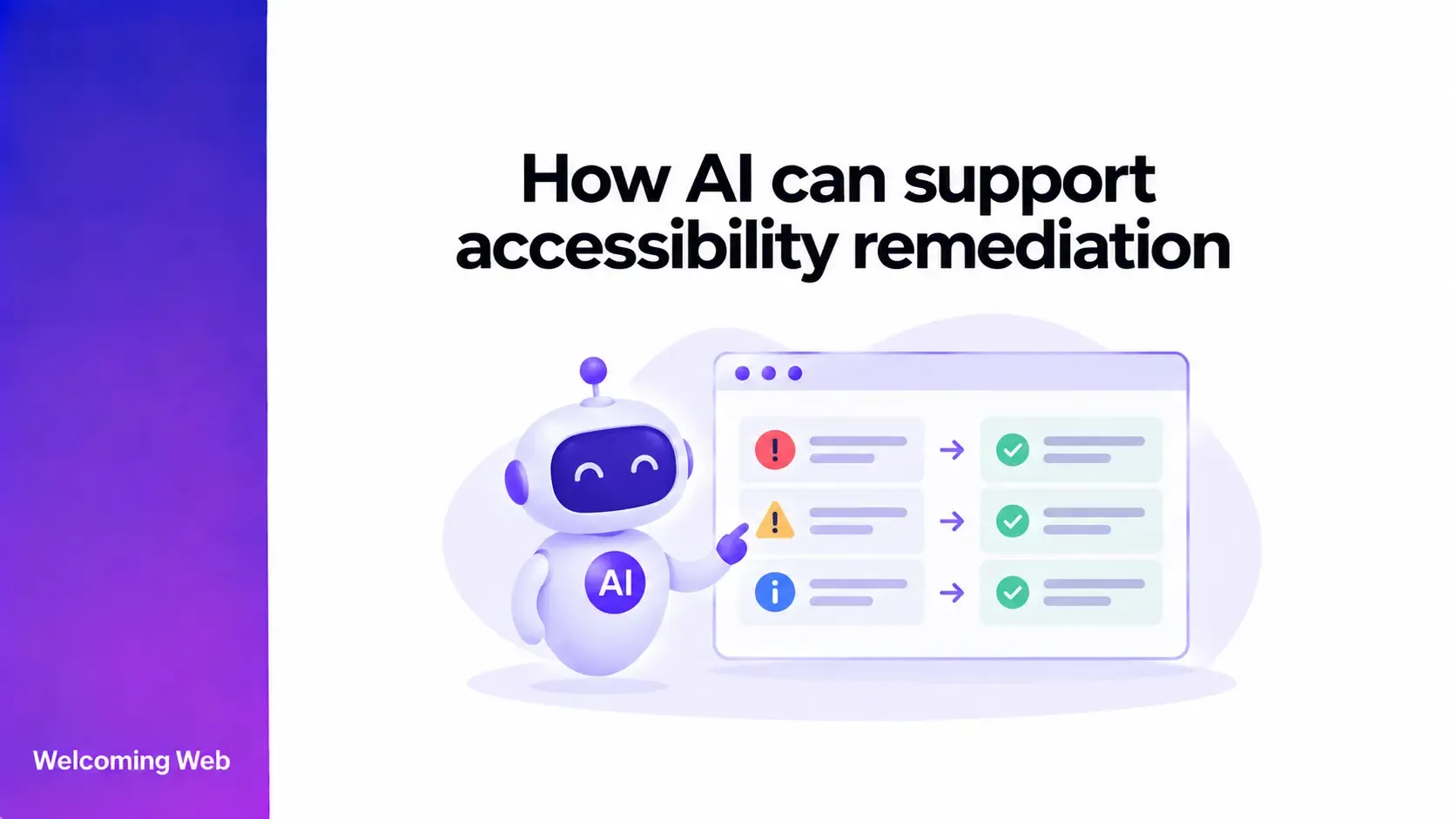
AI can extend automation into the remediation stage. For supported findings, it can analyse information about the affected element and generate a possible correction. The person responsible for the issue can then evaluate a proposed fix instead of beginning with the finding alone.
The role AI can play depends on the barrier. Issues with identifiable patterns and sufficient context are better candidates for AI-assisted remediation than problems involving complex interactions or subjective decisions.
How is AI changing the accessibility remediation process?
AI changes how remediation work moves through a team. Its impact is particularly noticeable when organisations are dealing with repeated findings or large accessibility backlogs.
Remediation can begin with a suggested fix
Accessibility reports traditionally tell teams what has failed and where the problem appears. Someone then needs to investigate the finding and work out how to correct it. AI can generate a remediation suggestion alongside supported findings. This moves the starting point from diagnosing a reported problem to evaluating a possible solution. For routine issues, this can reduce the time spent preparing corrections and make findings easier to move towards resolution.
Context can inform generated fixes
Some accessibility corrections depend on information surrounding the affected element. Alternative text is a useful example.
Detecting an image without alt text identifies the technical problem. Writing useful alternative text requires understanding what the image contributes to the page. AI can use available visual and page context to generate a possible description. This creates a more informed suggestion than simply identifying that the attribute is missing.
Repeated issues become easier to process at scale
Large websites can contain the same types of accessibility problems across many pages, templates, and pieces of content. Even relatively simple corrections become resource-intensive when they appear hundreds of times.
AI-assisted remediation can reduce some of this repetitive work for supported issue types. Teams can process suitable findings through a consistent remediation path instead of preparing every correction independently. This can be particularly useful for websites with large content inventories or frequent publishing schedules.
More teams can act on accessibility findings
Technical accessibility reports are not always easy for content editors, marketers, and other website owners to interpret. AI-generated remediation information can give these teams a clearer indication of what a supported finding means and how it could be corrected. Accessibility work can then reach the people responsible for affected content with more actionable information.
This can also leave accessibility specialists with more time for barriers involving complex interactions, assistive technology, and other areas where specialist evaluation adds greater value.
What makes an issue suitable for AI-assisted remediation?
AI-assisted remediation is most useful when an accessibility issue can be reliably identified and there is enough information to propose an appropriate correction. The suitability of a finding depends on several factors:
- A clearly identifiable barrier: The affected element and problem can be detected with sufficient reliability.
- A defined expected outcome: There is enough information about the accessibility requirement to understand what the correction should achieve.
- Useful context: The system has access to information that can inform an appropriate suggestion.
- A reviewable result: The proposed change can be checked to determine whether it addresses the original barrier.
Examples can include missing image descriptions, certain colour contrast problems, and unlabelled buttons or form fields. A technically small change can still require substantial judgement when the correct solution depends on meaning, purpose, or the wider interaction.
How can teams evaluate an AI-generated accessibility fix?
AI-generated fixes need to be checked to confirm they resolve the original accessibility issue. A correction can appear technically valid while still failing to address the barrier for users.
For fixes involving content, reviewers should check whether the suggestion communicates the correct meaning or purpose. An image description could accurately identify visible objects while missing the information the image contributes to the page.
Interaction changes may need keyboard, screen reader, or task-based testing. These checks can reveal whether the proposed correction works when someone uses the affected functionality.
Verification should therefore ask whether the original barrier has been resolved and whether the change has introduced any new problems.
What happens when AI cannot provide reliable remediation?
Some barriers require decisions that cannot be derived reliably from an automated finding. These issues need to move to the person or team capable of changing the underlying experience.
A content writer might need to rewrite confusing instructions. A designer may need to reconsider an interaction or information hierarchy. A developer could need to change keyboard behaviour, semantic structure, or component functionality.
A useful AI accessibility process therefore needs an escalation path. Supported issues can use AI-assisted remediation, while barriers requiring interpretation, redesign, or specialist testing move into the appropriate manual workflow.
How does AI change the remediation workflow for teams?
Adding AI means every accessibility finding no longer needs to follow the same remediation path. A typical workflow can include:
- Identify the barrier. Automated or manual testing surfaces an accessibility issue.
- Choose the remediation path. Determine whether the finding supports AI-assisted remediation or needs manual work.
- Generate a suggested correction. AI proposes a fix where sufficient information and support are available.
- Review the result. Check the suggestion for accuracy and suitability.
- Implement the correction. Apply the approved change through the appropriate workflow.
- Verify the outcome. Test the affected content or interaction again.
Separating findings by remediation path can also make ownership clearer. Content issues, development problems, design barriers, and specialist testing can be directed to the teams best equipped to resolve them.
Can AI accessibility remediation make a website WCAG compliant?
AI can support work towards WCAG conformance by helping teams resolve supported accessibility findings. Conformance depends on whether the applicable WCAG success criteria are satisfied across the website.
Some requirements can be assessed automatically, while others depend on meaning, interaction, and human evaluation. A website can therefore have no remaining AI-remediable findings and still contain accessibility barriers.
Teams working towards WCAG compliance need to combine appropriate automated testing and AI-assisted remediation with manual evaluation for requirements that cannot be determined reliably through automation.
How does Welcoming Web support AI-assisted remediation?
Welcoming Web's AI remediation tools help teams move supported accessibility findings towards resolution. Supported areas include issues such as missing image descriptions, low colour contrast, and unlabelled buttons or form fields.
Welcoming Web combines remediation assistance with scanning and monitoring, allowing teams to identify supported issues as their websites change and manage them within the same platform.
Issues involving context, complex interactions, or human experience can still require manual evaluation. Welcoming Web helps identify supported accessibility issues and provides remediation assistance, however, using the platform does not itself make a website accessible or certify WCAG conformance.
Build AI into the right parts of accessibility remediation
AI can reduce the manual work involved in resolving supported accessibility issues and help teams process larger remediation workloads. Its value depends on using it for findings where a useful correction can be generated and evaluated.
A strong remediation process gives supported issues an efficient route towards resolution while directing complex barriers to the people equipped to assess them.
Start using Welcoming Web today and get AI-assisted remediation suggestions that support your accessibility workflows.

Written by
Alisan Erdemli
CEO at Welcoming Web, and web accessibility technology expert
Connect on LinkedInReady to Make Your Website Accessible?
Join thousands of satisfied users who trust WelcomingWeb to deliver fully accessible, compliant, and inclusive digital experiences.