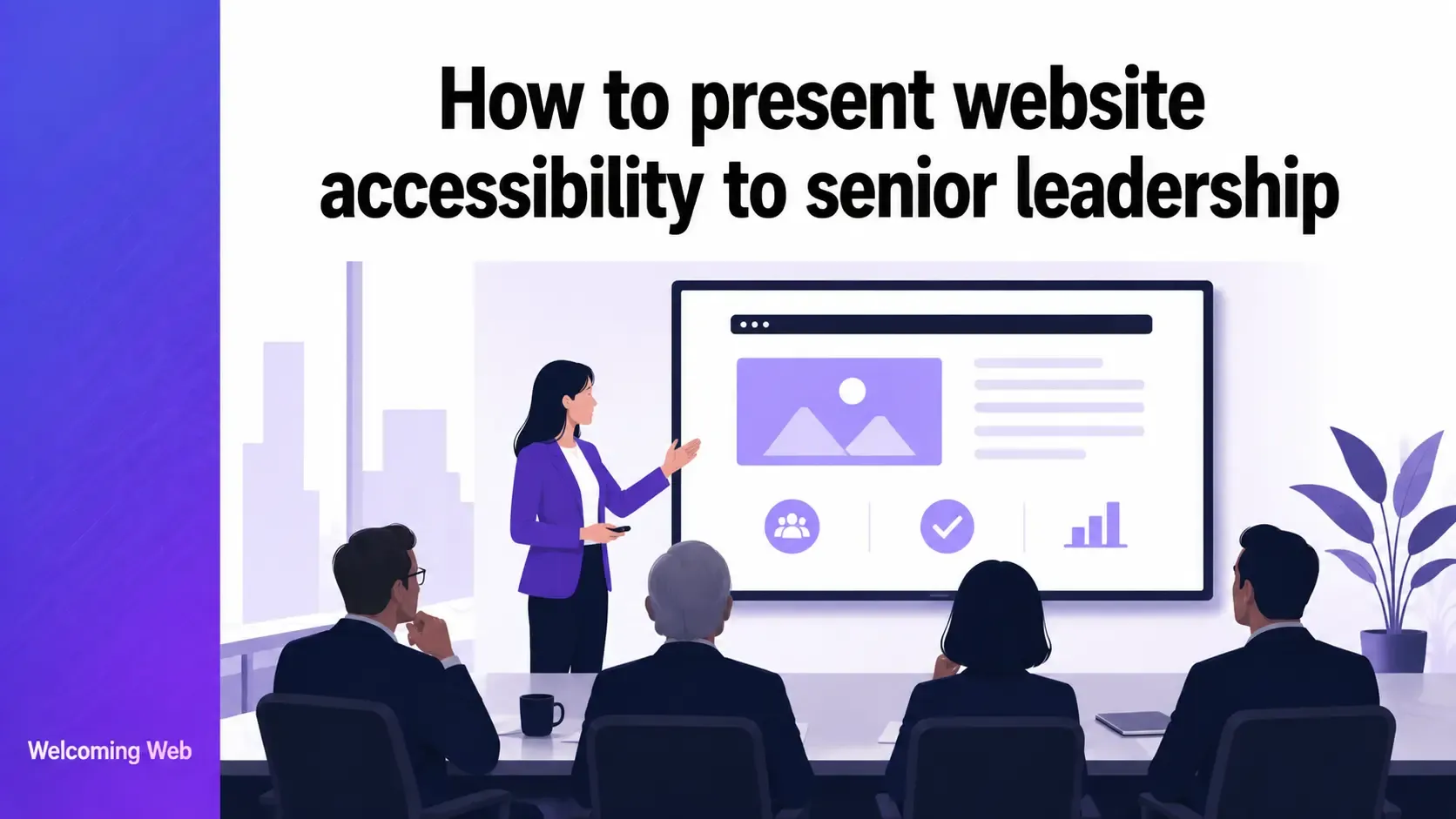
When you present website accessibility to senior leadership, the audience wants answers to three questions: what is the risk of doing nothing, what does it cost to address, and what does the organisation gain by acting. Presentations that answer all three with specific evidence produce decisions. This guide covers how to frame the argument, which evidence lands, and how to handle common objections.
Why does the accessibility conversation fail at senior leadership level?
The most common reason teams struggle to present website accessibility to senior leadership is that they frame it as a technical or ethical matter rather than a business one. A presentation that leads with WCAG criteria, compliance monitoring reports, or the moral case for inclusion gives senior leaders no basis for making a prioritisation decision. They are not equipped to evaluate the technical argument, and the ethical argument has no competitive frame that connects it to a decision they need to make.
Senior leaders make decisions based on risk, revenue, and reputation. Framing accessibility in those terms is what separates a presentation that produces a decision from one that gets deferred.
How does the accessibility argument land differently depending on who is in the room?
Understanding what motivates the specific leaders in the room is the most important preparation step when you present website accessibility to senior leadership. Each executive function has a different primary concern, and the same accessibility argument lands very differently depending on who is hearing it.
A CEO or managing director is most concerned with strategic risk, competitive position, and organisational reputation. Connecting accessibility to brand perception and the public consequences of being named in a lawsuit or regulatory investigation speaks directly to that concern. A CFO or finance director wants to see a risk-adjusted cost comparison: the cost of proactive accessibility work placed alongside the cost of reactive remediation plus legal fees after a complaint. That framing turns accessibility from a budget request into a risk management decision.
A chief marketing officer responds to market size and customer retention arguments. The revenue lost to inaccessible websites and the spending power of disabled consumers are the figures that land with this audience. Both are well documented from primary sources and connect accessibility directly to commercial outcomes a CMO is already tracking.
A chief legal officer or general counsel is already motivated by exposure. The most effective frame for this audience is what the organisation can show it has done. ADA Title III litigation has grown significantly year on year, and a legal lead who understands that documented accessibility effort shapes legal outcomes will ask what the organisation's current scan record looks like.
How do you structure a board-level accessibility presentation?
Knowing how to present website accessibility to senior leadership effectively comes down to structure as much as content. A board-level presentation should be short, specific, and structured around decisions. Senior leaders are not looking for a comprehensive briefing on accessibility. They are looking for what they need to know to approve, reject, or redirect a proposal. The structure that works consistently has four components:
- The current position: what the site's accessibility looks like right now, grounded in scan data rather than general assertions. The number of critical issues, the pages affected, and the WCAG criteria being failed give specificity to what would otherwise be a vague claim. A dated scan report turns a general statement about accessibility into a concrete picture of the organisation's current state.
- The risk of that position: the legal, reputational, and commercial cost of leaving it unchanged. This is where the litigation data, the revenue loss figures, and any relevant competitor examples belong. Concrete figures from primary sources give senior leaders a quantified picture of the cost of inaction.
- The proposed approach: what the organisation needs to do, who needs to do it, and what it will cost. A phased plan with defined milestones, responsible parties, and a monitoring mechanism gives a board something specific to approve.
- The ask: a specific request for budget, resource, or commitment. Senior leaders make decisions when there is a clear ask in front of them, and a presentation that ends without one rarely produces a result.
Which evidence makes the accessibility risk concrete for senior leaders?
The evidence that lands with senior leadership is specific, attributable, and relevant to the organisation's own situation. Generic statistics about global disability populations are less persuasive than figures that connect to the organisation's market, sector, or risk profile.
Sector-specific legal data narrows the risk from something that happens to organisations in general to something that happens to organisations like this one. Retail, financial services, and healthcare are consistently the most targeted sectors in ADA litigation. A senior leadership team in one of those sectors will respond more urgently to that framing than to headline lawsuit numbers.
Competitor examples carry more weight than any external statistic. A named competitor that has received an ADA demand letter, faced regulatory action under the EAA, or been publicly named in accessibility litigation shifts the conversation from abstract risk to immediate relevance. If a direct competitor has faced consequences, the board stops asking whether the risk applies to them and starts asking how to get ahead of it.
The organisation's own scan data is the most persuasive evidence of all because it answers the specific question the board is asking: "How exposed are we specifically?" An accessibility scan can produce that picture and gives the entire presentation a concrete, site-specific foundation.
How do you handle common accessibility objections from senior leadership?
Every time you present website accessibility to senior leadership you will encounter predictable objections. Preparing for them before the meeting makes the conversation significantly more productive.
The most common is that the organisation has not had any complaints. The Click-Away Pound Survey found that only 8% of disabled users who encounter barriers contact the business. The remaining 92% leave without saying anything, which means the organisation has no visibility of the users it is failing.
Some senior leaders assume the legal team would surface accessibility as a risk if it were serious. Legal teams are notified when a complaint arrives, not before. By that point the remediation cost has compounded on top of the legal cost, and the timeline is no longer within the organisation's control.
The redesign deferral feels like a solution but rarely is. Accessibility issues that are not addressed before a redesign propagate directly into the new site unless the brief explicitly requires otherwise. The redesign becomes an opportunity only if accessibility is written into it from the start.
On cost, the question is not whether accessibility requires investment but whether investing now costs less than investing after a legal notice arrives. And the cost of delaying fixes grows with every month the site remains live with known barriers.
What should you leave with leadership after an accessibility presentation?
A presentation that does not leave behind supporting materials loses momentum as soon as the meeting ends. The most useful materials to provide are a one-page summary of the current position, the risk it represents, and the proposed approach, written without WCAG terminology. Teams that have already worked through building an accessibility business case internally will have most of this material ready to adapt. Alongside the summary, the scan report that underpins the risk assessment with critical issues highlighted, a clear timeline showing key milestones, and a brief note on what ongoing monitoring will look like.
Welcoming Web's exportable reports in PDF and CSV format serve exactly this purpose. The dashboard produces a dated record of the site's accessibility position that can be shared with senior leadership as evidence of the current state and updated regularly to show progress. View Welcoming Web's pricing and start improving your site today.

Written by
Alisan Erdemli
CEO at Welcoming Web, and web accessibility technology expert
Connect on LinkedInReady to Make Your Website Accessible?
Join thousands of satisfied users who trust WelcomingWeb to deliver fully accessible, compliant, and inclusive digital experiences.