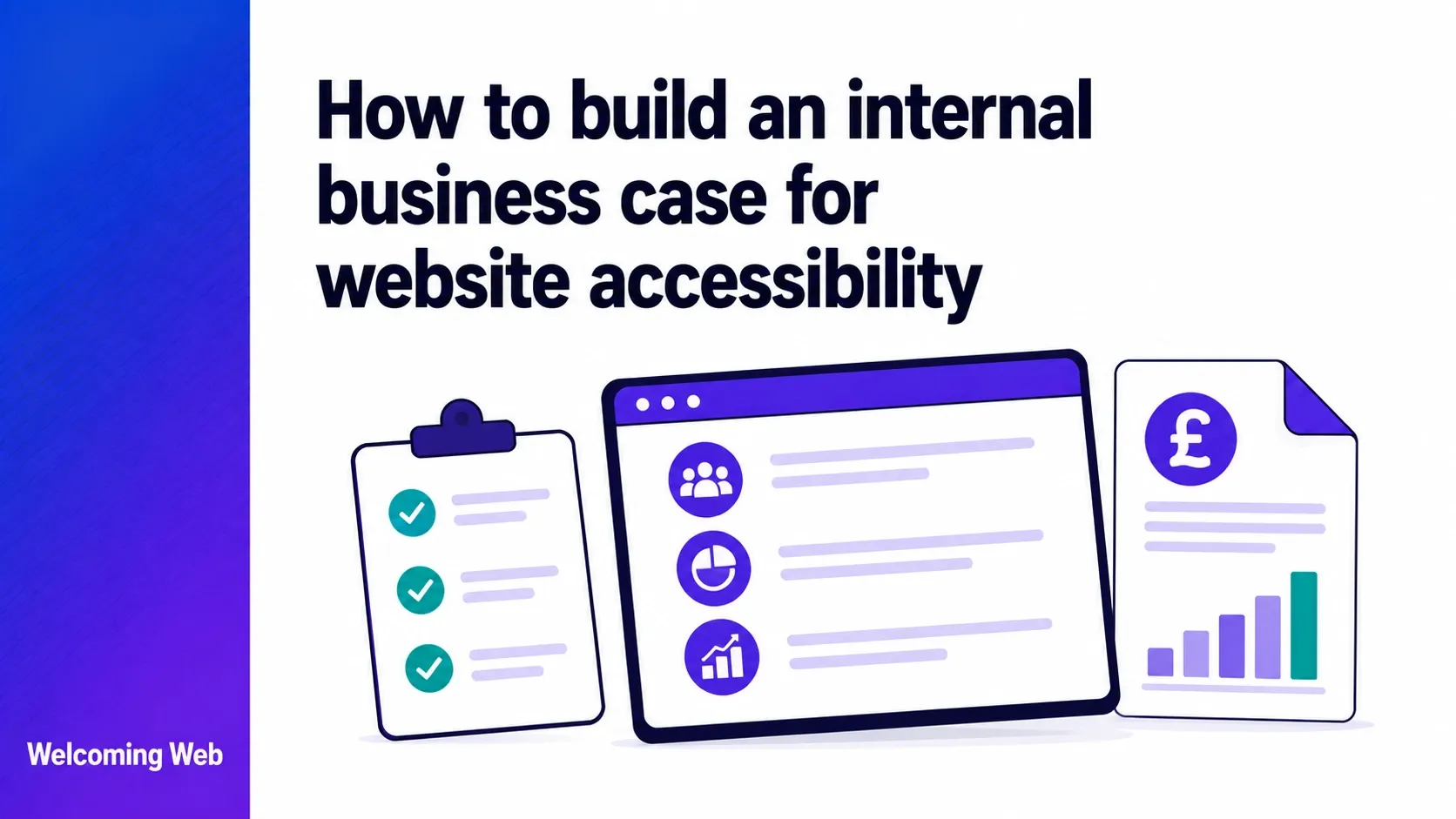
Building an internal accessibility business case is rarely about convincing people that accessibility is important. The challenge is translating that agreement into a prioritisation decision, securing budget, developer time, and organisational commitment from people with competing demands on all three. This guide covers how to frame the accessibility business case for different audiences, what evidence to use, and how to structure it in a way that produces a decision.
Why do accessibility business cases fail to get approved?
Accessibility business cases fail for a consistent reason: the framing does not match the audience. Teams that lead with compliance and legal risk often get a response along the lines of "we haven't been sued yet." Teams that lead with inclusion and values get a response along the lines of "we agree it's important but it's not the right time."
Neither framing connects accessibility to the specific metrics and objectives the decision-maker is already accountable for. The W3C's Web Accessibility Initiative makes this point directly: a compelling business case highlights the most relevant accessibility benefits within the organisation's specific operational landscape. There is no single version of the accessibility business case that works for every organisation. The version that works maps to the goals, risks, and language of the person being persuaded.
Who are you building the accessibility business case for?
The accessibility business case looks different depending on who needs to approve it. Understanding your audience before building the case is the most important step in the process.
A CFO or finance lead cares about cost, risk, and return. The most effective frame is a risk-adjusted cost calculation: the current cost of remediating the site's accessibility issues, the probability of a legal claim based on the sector and current barrier count, and the likely settlement and legal defence cost if a claim proceeds. Placing those figures side by side makes the cost of inaction concrete. A dated accessibility scan report that shows specific issues and severity ratings gives a finance lead something to work from rather than a general assertion about legal exposure.
A marketing or commercial lead cares about customers, conversion, and brand. The most effective frame connects accessibility to revenue. The American Institutes for Research found that working-age adults with disabilities in the US hold approximately $490 billion in after-tax disposable income. A significant portion of that spending flows online, and the Click-Away Pound Survey found that UK retailers alone lose £17.1 billion in annual online sales because their websites are too difficult for disabled users to use. Both figures make the same commercial argument: inaccessible websites are actively turning away a large and economically significant customer segment.
A product or engineering lead cares about technical quality, maintainability, and development efficiency. The most effective frame connects accessibility to code quality. Semantic HTML, keyboard accessibility, and ARIA implementation are practices that improve the underlying robustness of components regardless of their accessibility benefit. The cost of fixing accessibility issues during development is significantly lower than fixing them after launch, which resonates with any lead who manages a technical backlog.
A legal or compliance lead is already motivated by risk. Courts and regulators assess the quality of an organisation's documented accessibility effort when complaints arise, which makes the remediation record more valuable than a one-time audit. ADA Title III litigation has grown significantly year on year, and a compliance lead who understands this will prioritise ongoing monitoring over periodic reviews.
What evidence makes the strongest accessibility business case?
The evidence that makes a business case land is specific, attributable, and relevant to the organisation's situation. Generic statistics about global disability populations are less persuasive than figures that connect directly to the organisation's own market, sector, or risk profile.
Market size and revenue opportunity. Analytics tools do not capture what proportion of site visitors rely on assistive technology, which means most organisations are underestimating their disabled audience. The Click-Away Pound Survey's finding that only 8% of disabled users who encounter barriers contact the business means the revenue loss is invisible in standard reporting. Presenting this to a commercial stakeholder as hidden abandonment rather than a disability statistic reframes the evidence in terms they already track.
Legal risk quantification. The organisation's own accessibility scan results are the most compelling legal risk argument available for a legal or compliance audience. Sector-wide litigation trends establish that the risk is real. The scan provides the site-specific evidence that makes that risk concrete for the specific decision-maker being persuaded.
Competitive positioning. A 2024 Samsung UK survey found that 76% of disabled adults would stay loyal to companies offering accessible options, and 56% would pay more for a fully accessible product. An accessible competitor capturing that loyalty represents a measurable market share argument.
Internal cost data. If the organisation has already received a demand letter, undertaken any remediation work, or paid for an accessibility audit, those costs are internal data points that make the business case concrete without relying on external statistics.
How do you structure the accessibility business case document?
A business case document that produces a decision has four components, presented in an order that matches how decision-makers process information. These components include:
- The problem statement. What is the current state of the site's accessibility, and what does that mean for the organisation? This section should be grounded in scan data rather than general assertions. The number of critical issues, the pages affected, and the WCAG criteria being failed give the problem statement specificity.
- The cost of inaction. What is the financial, legal, and reputational cost of leaving the current state unchanged? This is where the legal risk quantification and revenue opportunity evidence belongs. The cost of inaction framing works better than the cost of action framing for most decision-makers because it reframes accessibility as a risk management decision.
- The proposed approach. What does the organisation need to do, who needs to do it, and what will it cost? This section should distinguish between content-level fixes that do not require developer time and structural fixes that do, because the resource ask looks very different depending on which category the majority of issues fall into.
- The expected outcome. What does success look like and how will it be measured? This section should include specific metrics: the number of critical issues to be resolved within a defined timeframe, the monitoring cadence that will catch regressions, and the documentation that will be produced for compliance purposes.
How do you get accessibility onto the roadmap and keep it there?
Getting a "yes" on the initial business case is only part of the challenge. Accessibility work that is approved once and then quietly deprioritised in the next sprint is a pattern most accessibility advocates will recognise.
The most effective way to keep accessibility on the roadmap is to make it visible through regular reporting. A monthly or quarterly accessibility report that shows which issues have been resolved, which are new, and how the overall issue count is trending gives stakeholders a continuing signal that the work is happening and producing results. It also creates a dated record of effort that serves the external compliance documentation that regulators and legal teams increasingly ask for.
Welcoming Web's exportable reports in PDF or CSV format serve both functions: internal stakeholders get a progress update and legal and compliance teams get the evidence of active effort that shapes outcomes if a complaint is made.
How do you handle common objections to the accessibility business case?
Every accessibility business case encounters objections. Knowing how to respond to the most common ones in advance makes the conversation more productive.
"We haven't been sued yet." Thousands of organisations have received ADA demand letters without any prior warning or complaint. A more useful question is whether the site's current accessibility position would hold up if a complaint were made tomorrow, and whether there is a documented record of active effort to support that position.
"Our users don't have disabilities." No organisation has reliable data on what proportion of its users rely on assistive technology, because standard analytics do not capture this. The users the site is failing are leaving silently and not appearing in any feedback channel. The absence of complaints is not evidence of an accessible experience.
"We'll address it in the next redesign." Accessibility issues that are not addressed in the current codebase will propagate into the next redesign unless accessibility is explicitly built into the redesign brief. A redesign that does not include accessibility requirements from the start will produce a new site with the same underlying issues.
"The cost is too high right now." As covered in our piece on the cost of delaying accessibility fixes, the cost of addressing accessibility issues grows over time as inaccessible decisions propagate. Addressing them now costs less than addressing them in twelve months, and significantly less than addressing them after a legal notice arrives.
The right framing makes the accessibility business case land
Most organisations already have enough evidence to make a compelling accessibility business case. What most accessibility advocates lack is the right version of that evidence for the specific audience they are presenting to. A CFO who dismisses a compliance argument will respond to a risk-adjusted cost calculation. A marketing lead who ignores legal risk data will respond to a market size argument.
Getting the business case approved is the first step. Sustaining it requires making progress visible through regular reporting, so accessibility remains a continuing conversation rather than a periodic campaign. A free accessibility scan with Welcoming Web gives you the site-specific data the business case and every subsequent progress report builds on.

Written by
Alisan Erdemli
CEO at Welcoming Web, and web accessibility technology expert
Connect on LinkedInReady to Make Your Website Accessible?
Join thousands of satisfied users who trust WelcomingWeb to deliver fully accessible, compliant, and inclusive digital experiences.