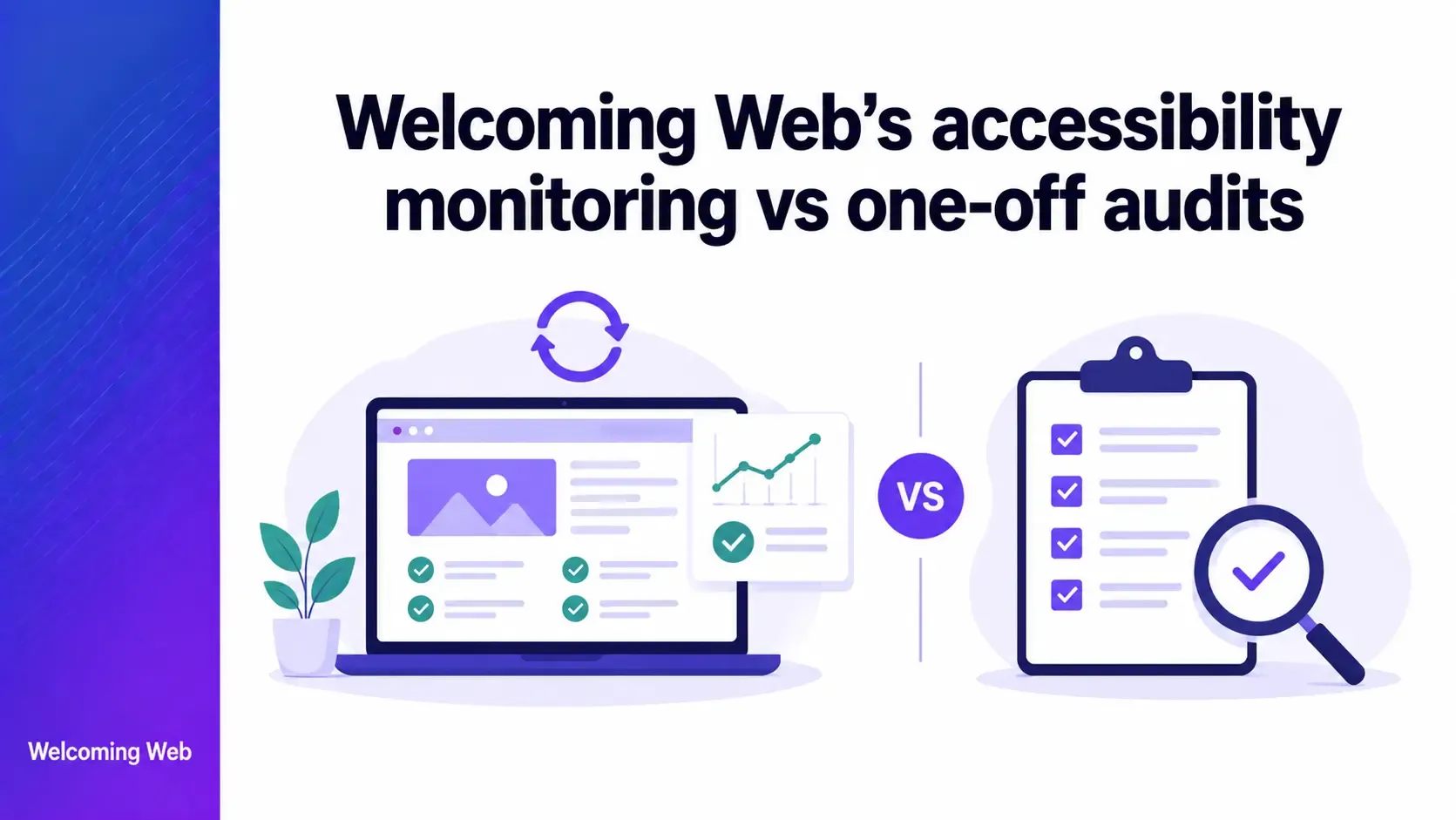
A one-off accessibility audit tells you where your site stands at a specific moment, but the moment it completes, the site begins to change. New content is published, features are released, plugins are updated, and the accessibility position shifts. Welcoming Web's accessibility monitoring tool is built for what comes after the audit. The six points below cover how the two approaches differ.
What is the difference between an accessibility audit and accessibility monitoring?
A one-off accessibility audit is a structured evaluation of a website against WCAG standards at a specific point in time. It combines automated scanning and manual testing to produce a comprehensive issue list. An audit tells you where the site stands today.
Welcoming Web's accessibility monitoring runs automated scans on a recurring schedule, weekly or monthly, and compares each result against the previous one. Rather than replacing a manual audit, it maintains visibility of the site's accessibility position after the audit is complete, catching regressions as they are introduced, tracking whether fixes hold, and producing a continuously updated compliance record.
The six differences below cover what that means in practice for teams managing accessibility on an ongoing basis.
1. Monitoring identifies regressions before users encounter them.
A one-off accessibility audit produces a list of issues that exist at the moment it is conducted, with no visibility of what is introduced after it completes. When a developer updates a shared component two weeks after the audit, when a designer changes a colour token that drops the contrast ratio below the required threshold, or when a new third-party plugin introduces a keyboard trap, those regressions are invisible to the completed audit.
Welcoming Web's accessibility monitoring runs scans on a schedule and compares each result against the previous one. An issue that was not present in the last scan but appears in the current one is flagged as new, distinguishing it from pre-existing issues and pointing directly to the change that introduced it. A regression caught the day after a deployment takes minutes to fix. The same regression found three months later, after it has propagated across new content, is a substantially larger remediation task.
2. The compliance record reflects the current state of the site
An accessibility audit report documents where the site stood on the day it was conducted. That document ages immediately. A report produced six months ago reflects a site that may have changed significantly since. When a regulator, a procurement team, or a legal representative asks for evidence of accessibility compliance, a six-month-old audit report is a weaker document than a current one.
With Welcoming Web's dashboard, you get a running record of every scan, the issues found, and whether they were resolved or have reappeared. That record is exportable in PDF or CSV format at any point. The compliance documentation it produces reflects the current state of the site and shows a continuous history of active accessibility work. For organisations facing procurement requirements or legal scrutiny, the difference between a dated scan history and a one-off report is significant.
3. Issue status is tracked across every scan instead of being listed once
An audit produces a flat list of accessibility issues. It tells you what is wrong but gives you no visibility of what happens next. Once the audit report is handed over, there is no mechanism to track which issues have been fixed, which have been partially addressed, which have reappeared, and which remain outstanding.
Welcoming Web tracks the status of every issue across scans. Each issue is marked as new, fixed, or reappearing. A fix that was applied but did not fully take effect, or that was overridden by a subsequent code change, shows as reappearing. Teams always have a current picture of where the remediation programme stands.
4. Coverage scales as the site grows and new pages are added
A one-off audit covers a defined set of pages agreed at the start of the engagement. New pages published after the audit scope was set are not covered. New templates introduced after the audit are not tested. An ecommerce site that adds fifty new product pages a month, or a news site that publishes daily content, will have significant unchecked accessibility surface within weeks of the audit completing.
Welcoming Web's monitoring scans can be configured to cover the site as it grows, running across all pages or a representative sample on a recurring schedule. New pages are included in subsequent scans without requiring a new scope agreement or a new audit engagement.
5. Developer handover stays current throughout the remediation period
Single audits typically result in a single handover document: the audit report, often supplemented by a prioritised issue list. That document is handed to the development team, work begins, and the handover is complete. If the remediation takes months, if the development team changes, or if new issues emerge during the remediation period, there is no updated document to reflect the current state of the work.
The exportable reports from Welcoming Web can be generated at any point and reflect the current scan results. A developer who joins the team six months into a remediation programme can run a fresh export and see which issues remain, which have been fixed, and which have reappeared since the last fix was applied. The handover document therefore remains current.
6. Accessibility stays visible on the team's agenda between audit cycles
A one-off audit places accessibility on the agenda for the period of the engagement and the immediate remediation period that follows. Once the remediation is complete and the report is filed, accessibility tends to drift back down the backlog unless something forces it back up: a legal notice, a user complaint, or a new audit commissioned months later.
Welcoming Web's monitoring keeps accessibility visible through regular reporting. A monthly or quarterly scan report that shows which issues are new, which have been resolved, and how the overall issue count is trending gives teams a continuing signal that accessibility is an active programme. That visibility is what sustains accessibility work between audit cycles and keeps the site's accessibility position from drifting as the site evolves.
Monitoring and audits work best together
Accessibility monitoring and a one-off audit serve different purposes and are strongest in combination. An audit establishes the baseline: a comprehensive assessment of the site's current accessibility position against WCAG standards, combining automated scanning and manual testing. Monitoring maintains that baseline after the audit is complete, catching regressions, tracking remediation progress, and producing the dated compliance record that regulators, procurement teams, and legal counsel increasingly ask for.
A free accessibility scan with Welcoming Web takes 60 seconds and gives you a starting point whether you have completed a formal audit or not. From there, scheduled monitoring keeps the picture current as the site evolves.

Written by
Alisan Erdemli
CEO at Welcoming Web, and web accessibility technology expert
Connect on LinkedInReady to Make Your Website Accessible?
Join thousands of satisfied users who trust WelcomingWeb to deliver fully accessible, compliant, and inclusive digital experiences.