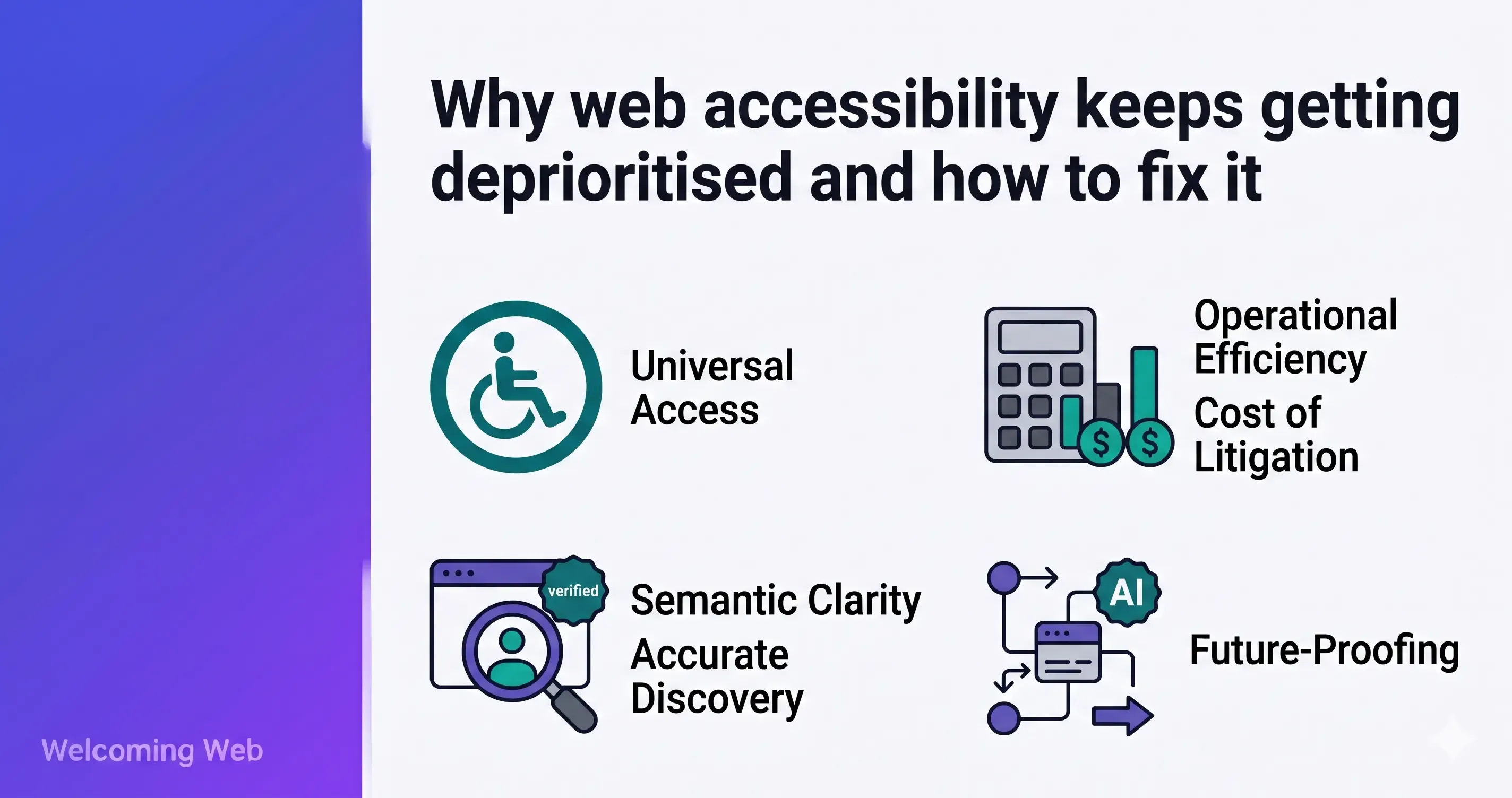
Web accessibility gets deprioritised because it lacks a clear owner, produces no immediate revenue signal, and sits in a backlog between tasks that feel more urgent. Digital teams know it matters, but they rarely dispute that. The problem is structural: accessibility work has no natural home in a sprint, no visible cost when ignored, and no obvious champion to fight for it. This post covers the real reasons it slips and what organisations that fix it do differently.
Why accessibility work disappears from the sprint backlog
Most digital teams treat website accessibility as a finishing task. That positioning almost guarantees it gets bumped because there is always something "more urgent" waiting behind it.
When a product manager faces a choice between a customer-facing feature with a direct revenue link and an accessibility fix with no clear metric attached, the feature wins. Every time. This is a clear prioritisation problem. Accessibility work has not been given the structure it needs to compete with those types of other choices.
A Click-Away Pound Survey found that 69% of disabled online consumers click away from websites they find difficult to use, taking with them an estimated £17.1 billion in lost UK online sales annually. Those figures represent revenue the site is actively turning away. If accessibility work were framed in those terms, it would not lose to a feature ticket.
Running a free accessibility scan on your site takes 60 seconds and gives your team a concrete issue list with severity ratings. That list is a far more actionable starting point than a general commitment to "improve accessibility someday."
What structural failures cause accessibility to keep getting deprioritised?
Four structural failures explain why accessibility keeps losing prioritisation conversations, regardless of how much a team cares about it.
- No single owner. Accessibility touches design, engineering, content, and compliance. When everyone is responsible, no one is accountable. Issues raised in design get closed by engineering as out of scope. Issues raised by legal never make it into the sprint.
- No visible cost to delay. A broken checkout flow shows up in conversion data within hours. Missing image descriptions on product pages show up nowhere, until a user complaint, a legal notice, or an audit surfaces them months or years later. Delayed visibility delays urgency.
- Framed as remediation. Organisations that treat accessibility as a catch-up project face an endless backlog. Every new feature adds new issues. Teams get demoralised when the list never shrinks. The organisations that escape this cycle treat accessibility as ongoing monitoring instead of a one-time sprint.
- No evidence of effort. Boards and leadership teams are increasingly aware of ADA and WCAG obligations. But without a dated record of what was checked, what was found, and what was fixed, there is no story to tell. Teams that cannot show progress cannot make the case for continued resource.
Who should own accessibility inside a digital team?
Accessibility needs a named lead. Without one, responsibility diffuses across design, engineering, content, and compliance and nothing gets done consistently.
The lead is usually a senior designer, a product manager, or a compliance officer. They set the standard, run the reporting cadence, and are accountable when something goes wrong. Each team that ships digital products owns accessibility within their area of expertise: engineering owns the implementation of fixes, design owns the component library, content owns image descriptions and link text.
For teams without a dedicated accessibility pipeline, Welcoming Web provides the scanning, monitoring, and remediation infrastructure the accountability lead needs to do their job without pulling reports from multiple sources.
What separates teams that maintain accessibility from those that keep deprioritising it?
The organisations that escape the deprioritisation cycle share a few characteristics. And none of them require a large team or a dedicated compliance budget.
- They scan on a schedule. A single manual audit captures a point in time. A scheduled scan catches the issues introduced by the next three feature releases. Running monthly or weekly scans means the issue list reflects the current state of the site, not the state it was in six months ago when someone last looked.
- They track issues over time. An issue list with no history is just a to-do list. A tracked history of what was found, when it was found, who addressed it, and when it was resolved is the foundation of a compliance story. Courts and regulators look more favourably on organisations that can show documented, active effort.
- They make the widget visible. The accessibility widget is the part of the product visitors interact with directly. It lets each visitor adjust text size, contrast, spacing, and keyboard behaviour without changing the site for anyone else. Keeping it off or hidden removes a visible signal that the organisation takes accessibility seriously.
- They attach numbers to the work. How many pages have critical issues? What share of visitors use assistive technology according to analytics? What does remediating this backlog cost now versus after a legal notice? Those conversations change how accessibility competes for resources.
How does an ADA demand letter change the cost of accessibility inaction?
An ADA demand letter does not create new accessibility problems. It creates a deadline, legal fees, and potential settlement costs around problems that already existed. Organisations that have documented their accessibility work consistently are in a fundamentally different position when one arrives.
The Department of Justice's Web Accessibility Guidance, published in 2022, confirmed that ADA Title III applies to websites. According to Seyfarth Shaw, a law firm that tracks ADA Title III litigation, 3,117 website accessibility lawsuits were filed in federal court in 2025 alone, a 27% increase from the previous year.
The organisations that weather accessibility complaints most effectively are those that can produce evidence of prior effort. A documented scan history and a record of issues addressed and resolved is evidence of good faith that shapes how complaints are handled. Courts and regulators consistently treat organisations that can show active effort differently from those that cannot.
What is the minimum viable accessibility programme for a small team?
Accessibility is not only an enterprise concern. Small teams can run a credible, documented programme with four components:
- a baseline scan that identifies what is currently wrong and at what severity,
- a priority fix list that addresses critical issues first,
- a monitoring schedule that catches regressions before they accumulate,
- and a record that can be exported and shown to a regulator or legal team if needed.
None of that requires a dedicated accessibility engineer. Welcoming Web's AI-assisted remediation generates suggested fixes for supported issue types, including missing image descriptions, unlabelled form fields, and contrast values that fail WCAG 2.2 thresholds. Teams review and approve suggestions before anything changes. No fix is applied without sign-off.
The accessibility widget handles the visitor-facing side from day one. Added via a single code snippet, it gives every visitor immediate control over how the site looks and behaves for them, with no changes to the underlying site design or code.
How do you start fixing the deprioritisation cycle?
Web accessibility stays deprioritised when it has no owner to build an accessibility business case, no monitoring schedule, and no evidence trail. None of those are difficult to build.
The teams that get this right have named someone accountable, committed to scanning on a schedule, and started keeping a record of the work. That record is what changes the internal conversation, and it is what matters most if a legal question ever arises.
A free accessibility scan takes 60 seconds and gives you the issue list you need to start. From there, the structural fixes described in this post are within reach for any team, regardless of size.

Written by
Alisan Erdemli
CEO at Welcoming Web, and web accessibility technology expert
Connect on LinkedInReady to Make Your Website Accessible?
Join thousands of satisfied users who trust WelcomingWeb to deliver fully accessible, compliant, and inclusive digital experiences.