ADA website compliance requires public-facing businesses to make their websites accessible to people with disabilities under Title III. WCAG 2.1 AA is the benchmark most commonly referenced in DOJ guidance, enforcement letters, and ADA settlement agreements. This guide gives legal and compliance teams a framework for assessing ADA exposure, identifying the failures that trigger lawsuits, and building an oversight programme.
What does ADA website compliance require in 2026?
ADA website compliance requires organisations to ensure their websites are accessible to people with disabilities. Courts, DOJ enforcement letters, and settlement agreements consistently reference WCAG 2.1 AA as the applicable technical benchmark. For legal and compliance teams, that means understanding both the legal obligation and the standard used to measure it. Welcoming Web's accessibility scanning maps every issue to the relevant WCAG 2.1 AA criterion. Compliance teams get a documented record of exactly where the site falls short.
The distinction is worth keeping straight. The ADA creates the legal obligation. WCAG describes what meeting it looks like in practice.
According to the WHO, around 1.3 billion people worldwide live with some form of disability. When a website is inaccessible, it excludes them from services, information, and transactions that everyone else takes for granted. That is the harm the law exists to prevent.
Why are ADA website lawsuits surging?
The primary enforcement mechanism for ADA digital accessibility is private litigation, not government investigation. ADA Title III gives individuals a direct right to sue in federal court without first filing a complaint with any agency. That structural feature has made web accessibility one of the most actively litigated areas of disability law.
Seyfarth Shaw's annual ADA Title III Lawsuit Report tracks thousands of federal web accessibility lawsuits each year, with the trend continuing upward over multiple years. E-commerce, financial services, healthcare, and hospitality companies face disproportionately high filing volumes. No public-facing website is insulated based on industry or company size.
A significant portion of this litigation follows a serial-litigation model. A small number of plaintiffs and law firms file large volumes of nearly identical complaints against companies whose websites share specific, repeatable failures: missing alt text, broken keyboard navigation, inaccessible checkout flows. Settling one complaint without fixing the underlying issues does not prevent the next one.
The litigation trend is compounded by state-level activity. California and New York have both seen legislative and regulatory attention to digital accessibility that supplements federal exposure. Organisations with operations or customer bases in multiple states face layered jurisdictional risk the federal framework alone does not fully capture.
DOJ enforcement letters to universities and healthcare organizations indicated that digital services are within scope. Patient portals, online scheduling systems, and learning management systems all qualify. Healthcare organizations and education institutions face regulatory scrutiny from both the DOJ and sector-specific agencies, which makes the compliance case particularly strong in those verticals.
How does an ADA complaint become a lawsuit?
Under ADA Title III, individuals can file suit directly in federal court without first filing a complaint with any agency. Most cases begin with a demand letter, a pre-litigation notice from plaintiff's counsel. Some companies negotiate resolutions at this stage. Others face a federal complaint if talks stall.
These cases typically seek injunctive relief rather than compensatory damages. The practical consequence is a court-supervised remediation timeline, which creates real operational burden when the website is complex or poorly documented. Attorney fee awards are a common feature of ADA accessibility cases and often represent the largest financial cost in settlements.
DOJ enforcement actions follow a separate pathway, relatively rare but high-profile. The agency typically targets organisations where non-compliance is systemic and public impact is broad: universities with inaccessible learning platforms, hospital systems with inaccessible patient portals.
Settlement agreements in both private and DOJ-initiated cases often extend well beyond remediation. Court-approved settlements frequently require ongoing monitoring by a third-party accessibility expert, regular reporting, and defined timelines for testing new features before deployment. Compliance teams inherit these obligations. The accessibility requirements embedded in a settlement agreement may run for two to three years after the original filing. That is long after engineering has moved on.
Which accessibility failures appear most often in ADA complaints?
Most websites that have never been audited against WCAG 2.1 AA compliance standards are carrying multiple failures. The same handful show up again and again in complaints and audits. The ones that are worth knowing by name include:
- Missing or inadequate alt text on images. Screen readers communicate image content through alt text attributes. When alt text is absent or generic, users who are blind or have low vision receive no meaningful information about the image.
- Low colour contrast ratios. WCAG 2.1 AA requires a minimum contrast ratio of 4.5:1 for normal-sized text against its background. Sites using light gray text on white backgrounds, or brand colors with insufficient contrast, routinely fail this criterion, and automated tools flag it in seconds.
- Keyboard navigation gaps. Users who cannot operate a mouse rely on keyboard commands to navigate. When dropdown menus, modal dialogs, or form fields are not keyboard-accessible, entire sections of a site are functionally unavailable to those users.
- ARIA misuse or absence. ARIA (Accessible Rich Internet Applications) attributes communicate the role and state of interactive elements to assistive technology. Incorrect or missing ARIA causes screen readers to describe elements in ways that confuse or mislead users, a particularly common problem in dynamic, JavaScript-heavy interfaces.
- Inaccessible PDFs. Downloadable documents are frequently excluded from accessibility audits. But PDFs used for forms, reports, and policies must carry tagged structure to be readable by screen readers. An untagged PDF is effectively invisible to assistive technology.
- Missing form labels and error identification. Contact forms, application forms, and checkout flows with unlabeled fields and unclear error messages create barriers for screen reader users and users with cognitive disabilities alike.
- Auto-playing media without controls. Video or audio that starts without user initiation, and cannot be paused or stopped, is disorienting for users with cognitive or sensory disabilities and violates multiple WCAG criteria.
Compliance teams reviewing their organization's exposure don't need to diagnose these failures themselves. However, they do need to understand the categories well enough to ask the right questions of their engineering and UX partners.
What do compliance teams need to know about WCAG 2.1 AA?
WCAG, the Web Content Accessibility Guidelines, is published by the World Wide Web Consortium (W3C). It carries no direct legal authority on its own. In practice, U.S. courts evaluating ADA Title III claims against websites routinely use WCAG 2.1 AA as the measure of whether a site meets its accessibility obligations.
The guidelines are organized around four principles. Content must be:
- Perceivable: Users must be able to perceive the information being presented, regardless of sensory capability.
- Operable: Users must be able to navigate and interact with the interface.
- Understandable: The information and operation of the interface must be comprehensible.
- Robust: Content must be reliably interpreted by a wide range of assistive technologies, across browsers and platforms.
WCAG 2.2 was published in October 2023 and adds additional success criteria, but WCAG 2.1 AA remains the current legal baseline in the majority of U.S. enforcement contexts. The DOJ's 2024 Title II final rule codifies WCAG 2.1 AA specifically for government sites, and plaintiff complaints against private businesses continue to reference 2.1 AA as the relevant standard.
Compliance teams don't need to master every individual success criterion, that work belongs to developers, QA engineers, and accessibility specialists. What compliance teams need is enough working knowledge of what WCAG measures to oversee vendor relationships, evaluate audit scopes, and hold remediation work accountable. Organizations that reference WCAG 2.1 AA conformance in their accessibility statements and remediation plans are also better positioned when responding to demand letters.
Who should own ADA website compliance inside an organisation?
Compliance and legal teams should own ADA website compliance. They already manage legal risk registration, vendor contracts, and regulatory response workflows. Accessibility risk fits the same function. For most of the past decade it landed elsewhere. Creative teams addressed it during redesigns. Developers fixed individual issues when someone flagged them. Legal risk never entered the conversation.
The consequences show up the moment a demand letter arrives. No owner. No remediation history. No audit trail showing good-faith effort. That gap in ownership is a governance problem.
The data privacy shift shows how this plays out. Before GDPR and CCPA, privacy was an IT problem. After enforcement began, ownership moved to legal and compliance, with privacy obligations embedded in vendor contracts, procurement checklists, and board reporting. Digital accessibility is on the same path. The litigation data already shows where enforcement is heading.
Compliance teams that take ownership before a demand letter arrives can build defensible documentation, hold vendors accountable, and avoid the court-supervised remediation timelines that follow reactive responses. An enterprise accessibility compliance programme needs the same things any regulatory compliance function needs: assigned ownership, documented controls, regular testing, and upward reporting.
What are the financial, reputational, and legal risks of ADA non-compliance?
ADA non-compliance carries three categories of risk that belong in any compliance team's risk assessment: financial, reputational, and operational.
Financial exposure includes plaintiff attorney fees recoverable under Title III, often the primary cost driver in settlements, internal legal hours responding to demand letters, the cost of court-ordered remediation on a compressed timeline, and third-party audit costs mandated by settlement terms. These costs recur in organizations that address accessibility reactively. Each settlement that fails to produce systematic remediation creates conditions for the next complaint.
Reputational exposure is less quantifiable but increasingly material. Public demand letters, press coverage of high-profile suits, and association with inaccessible practices carry ESG implications that reach board-level reporting at many organizations. Accessibility now appears in the same conversations as inclusion and corporate responsibility.
Operational exposure is the category compliance teams most often underestimate. Court-mandated monitoring requirements, third-party audit cycles embedded in settlement terms, and remediation timelines running concurrently with product development create sustained operational disruption. These obligations frequently outlast the personnel who negotiated the settlement.
Repeat litigation is a documented pattern among companies that settle individual suits without addressing root-cause failures. Resolving a specific complaint, rather than building a systematic program, does not close the exposure.
What does a realistic compliance roadmap look like?
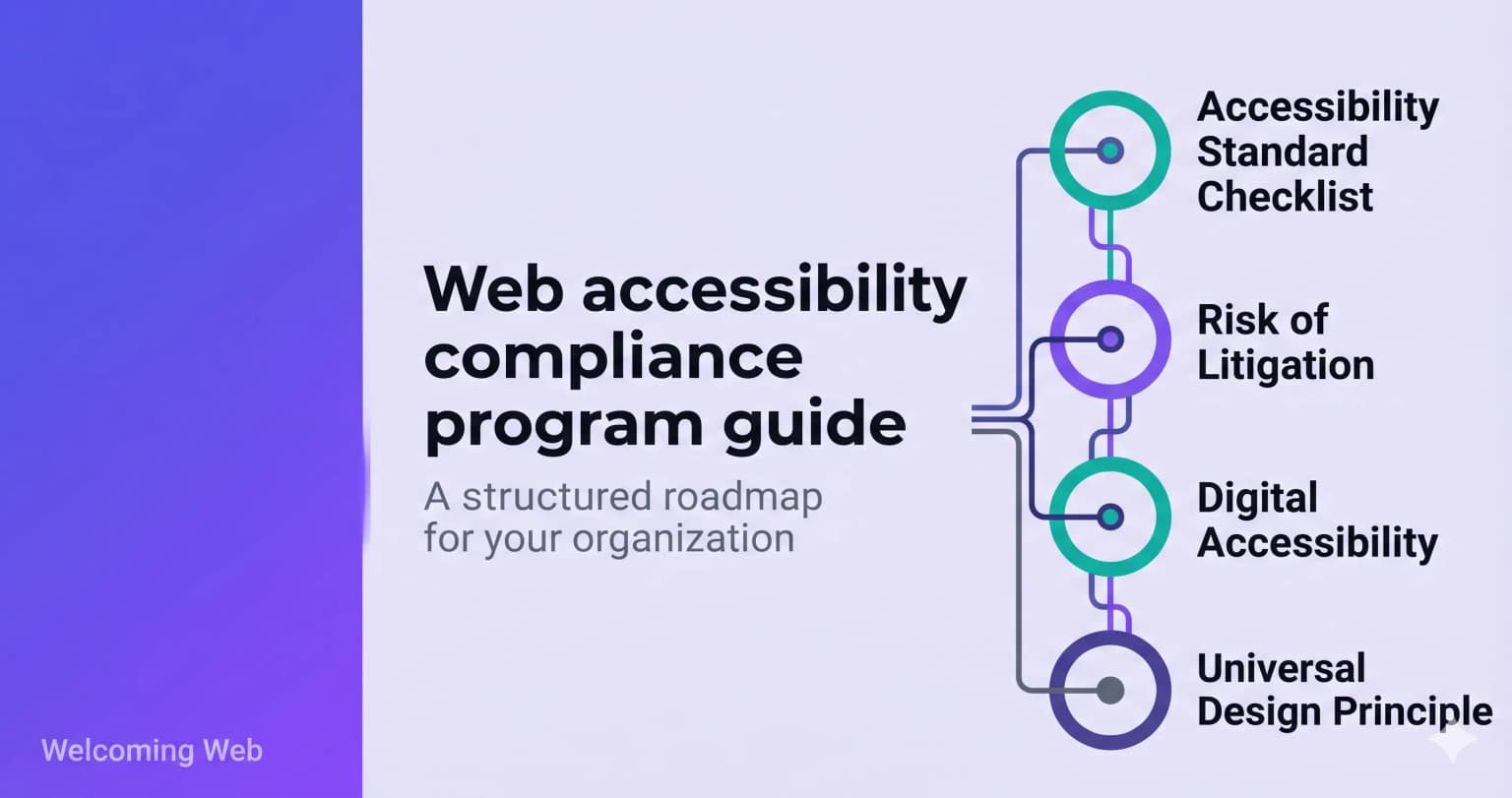
Most compliance teams approaching accessibility for the first time benefit from a phased framework that assigns clear ownership without requiring technical expertise at the compliance level.
Phase 1: Audit. Commission an independent accessibility audit that includes both automated scanning and manual testing against WCAG 2.1 AA. Automated tools alone identify approximately 30-40% of real accessibility issues. Manual testing by qualified accessibility specialists is needed for a defensible assessment. Scope should explicitly include public-facing pages, authenticated portals, mobile interfaces, and downloadable PDF documents.
Phase 2: Prioritization. Not all failures carry equal legal risk. Compliance teams should drive prioritization based on user impact and legal exposure, checkout flows, contact forms, authentication pages, and primary navigation represent higher risk than informational blog content. Legal risk visibility should govern the remediation sequence.
Phase 3: Remediation and vendor accountability. Assign remediation to engineering and design with documented timelines and owners. And include explicit accessibility requirements in vendor contracts and third-party SaaS agreements. Many accessibility failures originate in third-party plugins, embedded widgets, and externally hosted components, vendors who supply inaccessible code do not automatically share legal exposure.
Phase 4: Ongoing monitoring and policy. Accessibility requires ongoing maintenance. New content, redesigned components, third-party widget updates, and platform migrations routinely introduce new failures. Establish a monitoring cadence, periodic automated scans supplemented by scheduled manual reviews, and publish an Accessibility Statement describing the standard being targeted, how users can report issues, and a contact method for accessibility-related feedback. An Accessibility Statement demonstrates good-faith effort, and both courts and the DOJ consider it when evaluating organizational posture.
In practice, Phase 3 is where most programs stall. Vendor contracts are harder to renegotiate than internal workflows, and engineering teams resist accessibility acceptance criteria that slow sprint velocity. This is a governance problem and it belongs to compliance.
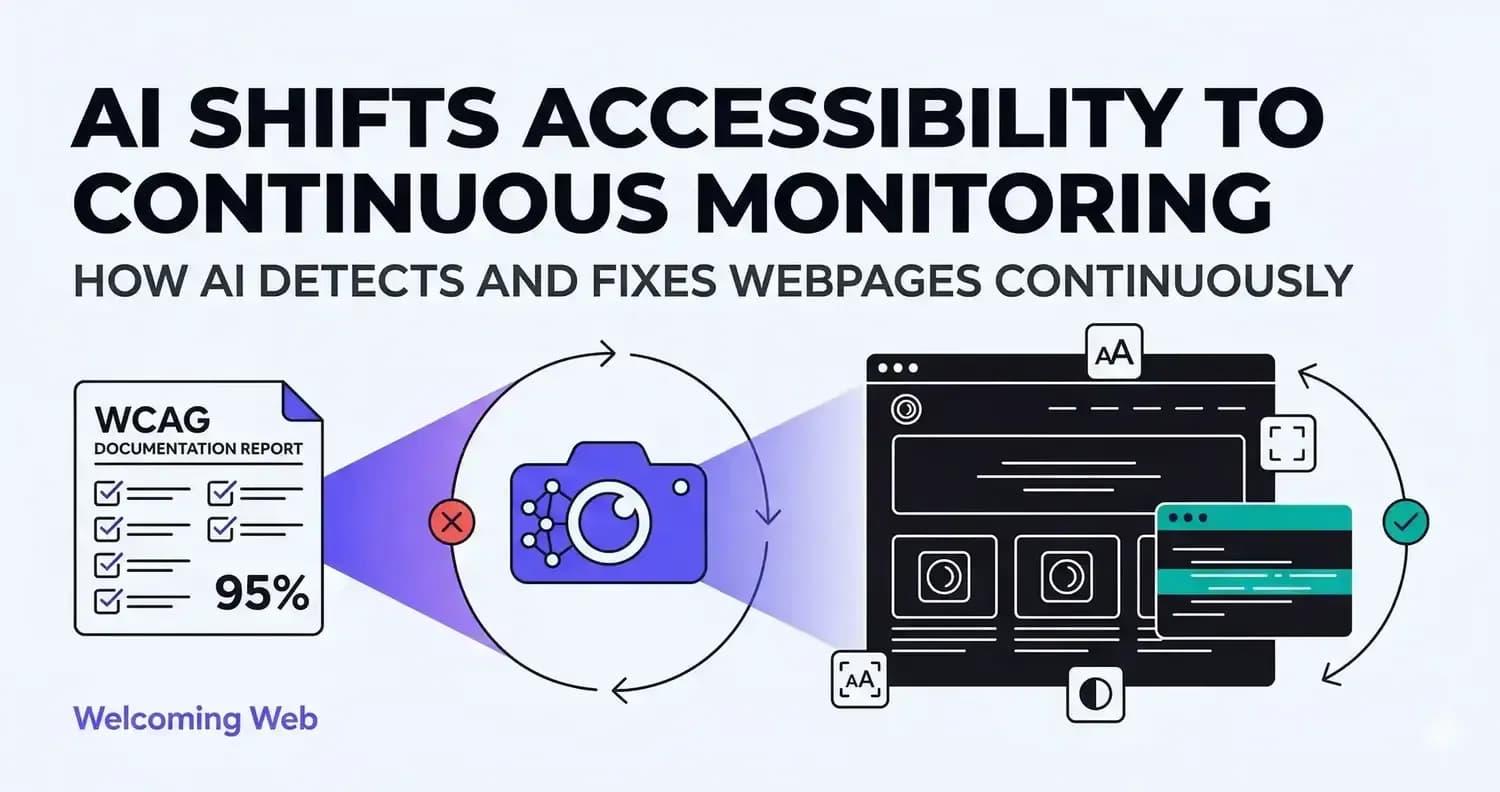
Welcoming Web supports the ongoing monitoring phase specifically, giving compliance teams visibility into new accessibility issues between formal audit cycles without requiring them to interpret raw technical output directly.
Compliance team checklist: assessing your ADA website risk
The checklist below is an organizational readiness assessment, not a legal audit. Use it to identify gaps in governance and process.
Current State
- Has a WCAG 2.1 AA audit been completed in the past 12 months?
- Does that audit include manual testing by a qualified specialist, not only automated scanning?
- Are PDFs and downloadable documents included in the audit scope?
- Are authenticated portals and mobile interfaces tested alongside the public-facing site?
Governance
- Is digital accessibility assigned to a specific owner in legal or compliance, not solely delegated to UX or engineering?
- Are accessibility requirements included in vendor procurement contracts and SaaS agreements?
- Does the website have a published Accessibility Statement?
- Does the organization have a defined response protocol for accessibility demand letters?
Remediation
- Are identified accessibility failures tracked in a formal log with assigned owners and deadlines?
- Are high-risk barriers such as checkout flows, forms, and navigation, prioritized over lower-priority informational content?
- Is remediation progress reviewed by compliance or legal and not only by engineering?
Monitoring
- Is there a process for testing new content and features for accessibility before deployment?
- Are third-party components and widgets included in periodic accessibility reviews?
- Is there a defined escalation path when accessibility complaints are received from users?
Should you take a proactive or reactive approach to ADA compliance?
Two organizational postures define how companies approach digital accessibility law in 2026: reactive remediation and accessible by default.
Reactive organizations address accessibility when a complaint or demand letter forces the issue. The consequences are predictable: compressed remediation timelines, court oversight, operational disruption, and ongoing exposure between settlement and actual implementation. The cost of redesigning an inaccessible component after it has been built and deployed is substantially higher than building it accessibly the first time.
Accessible by default means accessibility requirements are embedded in design systems, developer acceptance criteria, QA workflows, and vendor contracts before a complaint arrives. Most organizations start reactive. The roadmap above describes the path toward proactive.
Where organizations land on that spectrum tends to shift over time. Those that treat accessibility as an ongoing governance function, rather than a periodic remediation project, accumulate documented evidence of active effort and institutional knowledge that makes each subsequent audit less costly.
W
Welcoming Web is a web accessibility platform that supports continuous accessibility monitoring as part of a proactive compliance program, surfacing new issues as they appear between formal audit cycles without requiring compliance teams to interpret raw technical output directly.
The next steps for compliance teams
The most useful action your compliance team can take today to achieve ADA website compliance is to determine which phase of the four-phase roadmap your organization is currently in.
If no WCAG 2.1 AA audit has been completed in the past twelve months, including manual testing, scheduling an audit is the concrete first step. Assign clear ownership within legal or compliance rather than as a secondary responsibility within UX or engineering.
If an audit exists but governance and monitoring infrastructure do not, the priority is moving from Phase 1 findings to Phase 2 and Phase 3 ownership: a remediation log, vendor contract language, and a published Accessibility Statement.
If monitoring is the gap, that is where Welcoming Web helps. It gives compliance teams continuous visibility into their ADA compliance monitoring posture between formal audit cycles, without requiring them to interpret raw technical output directly.
See exactly which WCAG 2.1 AA issues your site has in 60 seconds. A free accessibility scan gives compliance teams a documented baseline against WCAG 2.1 AA, showing which pages, which elements, which success criteria are affected.

Written by
Alisan Erdemli
CEO at Cinema8, and e-learning technology solutions expert
Connect on LinkedInReady to Make Your Website Accessible?
Join thousands of satisfied users who trust WelcomingWeb to deliver fully accessible, compliant, and inclusive digital experiences.